What the contract histories of America's space champions show about what Europe is actually missing.
Get one email when a new edition is out
Every explanation of Europe's lag in commercial space eventually reaches for culture. The contract records of America's champions point somewhere more concrete: at the largest and most deliberately designed customer in the history of the industry. This first edition of The Demand Side examines what that customer actually did, how Europe's public buyers behave instead, and how the difference can be measured, firm by firm.
In this edition
- Executive summary
- 1. A diagnosis worth getting right
- 2. Reading the contract histories
- 3. How the American customer works
- 4. The transatlantic ledger
- 5. How Europe buys
- 6. Seven European firms under the same lens
- 7. The strongest objection, taken seriously
- 8. What follows
- 9. The scoreboard, and what comes next
- Method, sources and disclosure
Executive summary
This study reads the histories of America's most celebrated space companies through their contracts, compares public buying power on both sides of the Atlantic, and applies a coded framework to seven European NewSpace firms. Five findings organise the argument.
One. At every decisive moment in the histories of SpaceX, Iridium, Planet Labs, Varda, Firefly, Rocket Lab and Axiom, the signature on the pivotal contract belonged to a government. Entrepreneurial execution turned those contracts into companies; the contracts supplied the demand that made execution worth financing.
Two. The United States operates the industry's largest and most deliberately designed public customer: roughly $79.7 billion of government space spending in 2024, deployed through two mechanisms Europe has been slow to copy. Anchor tenancy commits the state to buy outcomes at fixed prices while suppliers keep the spare capacity; the National Reconnaissance Office's ten-year imagery subscriptions, with disclosed ceilings above $4 billion for Maxar and BlackSky alone, show the model operating at segment scale. The defence premium adds a buyer that pays extra for guaranteed access and returns every year by law.
Three. Europe's position on private capital has improved beyond recognition: a record €1.5 billion raised in 2024 and a rise from roughly 3 to 22 percent of global private space investment within five years. The constraint that remains sits on the demand side. Europe's public customer is about six times smaller than America's, directs 88 percent of its budget to civil programmes while global growth is defence-led, specifies inputs through geographic-return rules, and arrives fragmented across more than twenty national buyers.
Four. Among seven European firms coded on public evidence, proximity to commercial scale follows the repeatability of the business model and the quality of demand behind the order book. ICEYE, Europe's strongest case, reached scale on sovereign buyers who behave commercially: repeat purchases of a standardised product, with capital arriving after the demand was demonstrated. Elsewhere, headline backlogs dissolve on inspection into conditional promises from customers that are themselves pre-revenue.
Five. The strategic-autonomy objection, that some space capability is a public good and owes nobody a market, deserves respect and has a boundary. It covers infrastructure. It stops at the growing population of ventures that raise private capital and recruit talent on commercial promises while living indefinitely on institutional revenue.
The policy conclusion follows from the evidence: Europe has spent three decades working on its supply of space companies. The higher returns now sit in the other column of the ledger, in the scale, design and quality of what its public institutions choose to buy.
1. A diagnosis worth getting right
Ask why Europe has no SpaceX and the answer arrives before the question has finished: culture. Americans dare, Europeans hesitate. The United States produces garage entrepreneurs; Europe produces grant applications. The explanation has the advantage of familiarity and the disadvantage of being unfalsifiable, which may explain its popularity on conference panels.
It also carries a policy price. A continent that diagnoses its space gap as cultural will prescribe accelerators, awareness campaigns and another generation of startup programmes. A continent that diagnoses it as a demand problem will redesign procurement, pool its buying power and measure firms by their customers. These prescriptions compete for the same political attention and the same public money. Thirty years into the first prescription, the results invite a second opinion.
European security spending is surging into orbit, private investment stands at record levels, the European Commission has proposed an EU Space Act, and ESA has begun experimenting with service-based procurement. The next five years of choices will determine whether that momentum builds markets or extends the familiar pattern of capabilities in search of customers. One more force shapes those choices: the state is returning as the lead actor, in a way the sector has not seen since the 1990s. The stakes sit in contract design: whether the returning state buys like a customer or spends like a patron will decide which layer grows. Europe's own senior policy voices now describe exactly this in print: a paradigm shift, space as a state task again (Schrogl, 2025).
Section 2 reads the contract histories of America's champions, setting brand narratives beside the awards that actually carried the companies. Section 3 examines the machinery behind those awards. Sections 4 to 6 turn to Europe: first the scale and structure of its public demand and the way it buys, then a coded comparison of seven European NewSpace firms built on public evidence. Section 7 takes the strongest counterargument seriously. Sections 8 and 9 draw out what follows for policymakers, investors and operators, and introduce the measurement project this publication exists to run.
2. Reading the contract histories
Corporate histories in space tend to be told as founder stories. The record supports a complementary telling, in which the protagonists are procurement officers. The cases below were chosen to span three decades, three business models and three failure modes; together they trace a single pattern.
Iridium: the rescue that set the template
The pattern predates NewSpace. Iridium, the satellite-phone constellation born at Motorola, entered Chapter 11 in 1999 under roughly $4 billion of debt, nine months after commercial launch; the handsets were expensive, the commercial market imagined for them barely existed, and the entire system was nearly deorbited. A private group bought the constellation's assets for about $25 million, and what made the purchase rational was a customer: in December 2000 the US Department of Defense signed an unlimited-use gateway contract, roughly $72 million for two years, that gave the Pentagon secure global communications and gave Iridium a revenue floor no commercial subscriber base could yet provide. The relationship deepened into the Enhanced Mobile Satellite Services arrangement, renewed in 2019 at $738.5 million over seven years. Iridium today is a profitable, twice-rebuilt constellation with a majority-commercial subscriber base. The sequence that saved it, public floor first, commercial growth second, would repeat across the industry for the next twenty years.
SpaceX: rescued by a customer, scaled by two
In the autumn of 2008, SpaceX was weeks from insolvency. Three consecutive Falcon 1 failures had consumed its founder's fortune; the fourth flight reached orbit with the company's remaining cash committed. What converted that engineering feat into a business was a buyer. NASA had placed a $278 million Commercial Orbital Transportation Services (COTS) agreement with SpaceX in 2006, paying fixed sums against demonstrated milestones. In December 2008 the agency signed a $1.6 billion Commercial Resupply Services contract for twelve cargo flights, and the company's survival stopped being in question. Commercial crew followed in 2014 at $2.6 billion. By 2021 the relationship had extended into the classified domain: SpaceX's Starshield division is building a reconnaissance constellation for the National Reconnaissance Office under a contract reported at $1.8 billion, with more than 180 satellites launched by 2025. Cumulative federal awards across NASA and the Department of Defense now run well past $20 billion. The commercial business built on this foundation is formidable. The foundation itself was public.
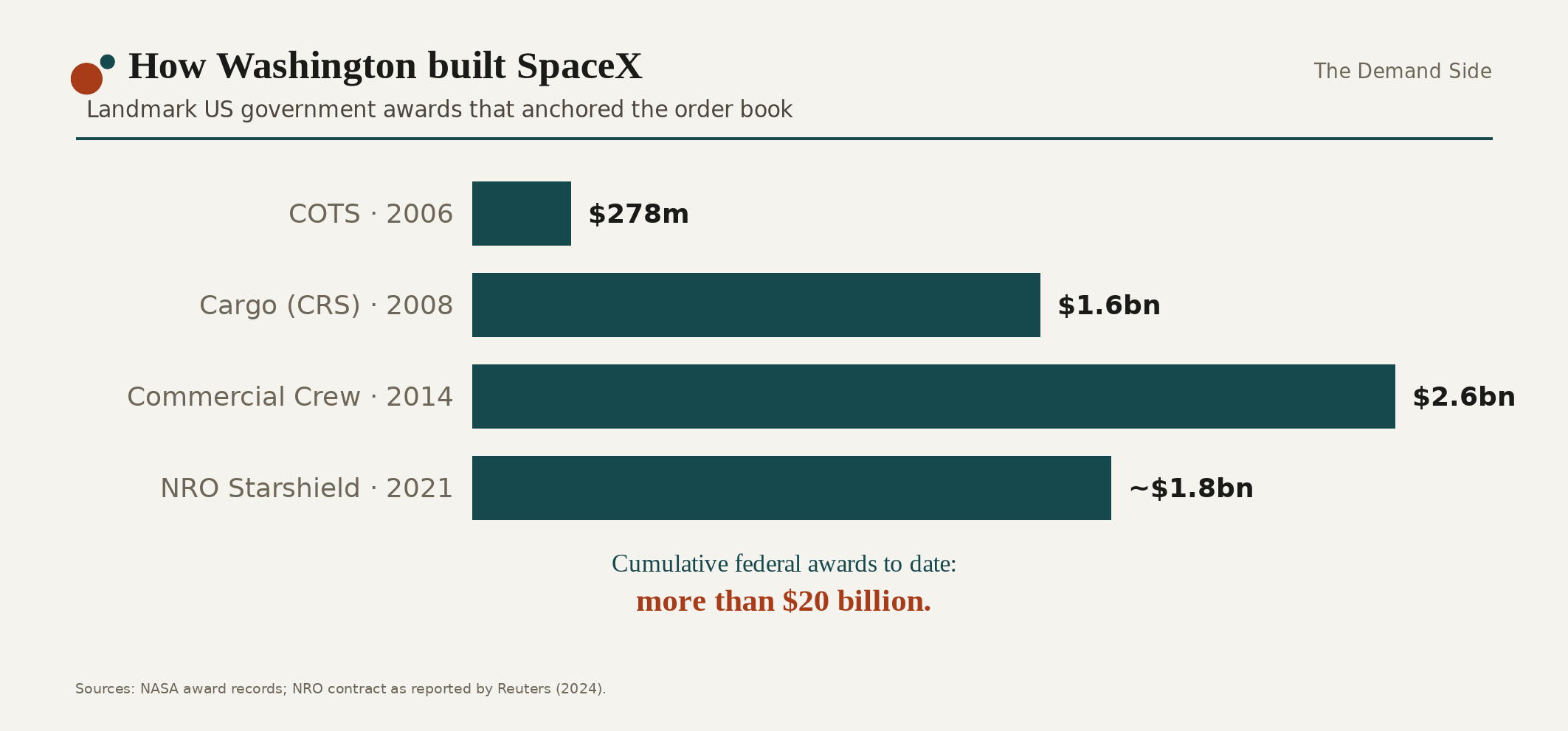
Chart 1. SpaceX's decisive moments were government awards. Values as publicly reported; the NRO contract remains classified and is reported by Reuters and others.
Planet Labs: the ledger and the brand
Planet was founded by former NASA engineers around an explicitly civilian idea: image the entire Earth every day and democratise access to the data, with agriculture and sustainability as flagship markets. The brand still tells that story. The revenue no longer does. In fiscal year 2026, 59 percent of Planet's revenue came from defence and intelligence customers, the segment grew more than 50 percent year on year, and the company's backlog rose 245 percent on contracts with the US Department of Defense, the German government and NATO. One fiscal year earlier, defence and intelligence had been the smallest reported slice of the business. Planet's commercial mission continues, and its imagery serves thousands of civilian users. The economics of the company, meanwhile, have reorganised themselves around the buyer that pays most, pays on time and renews every year.
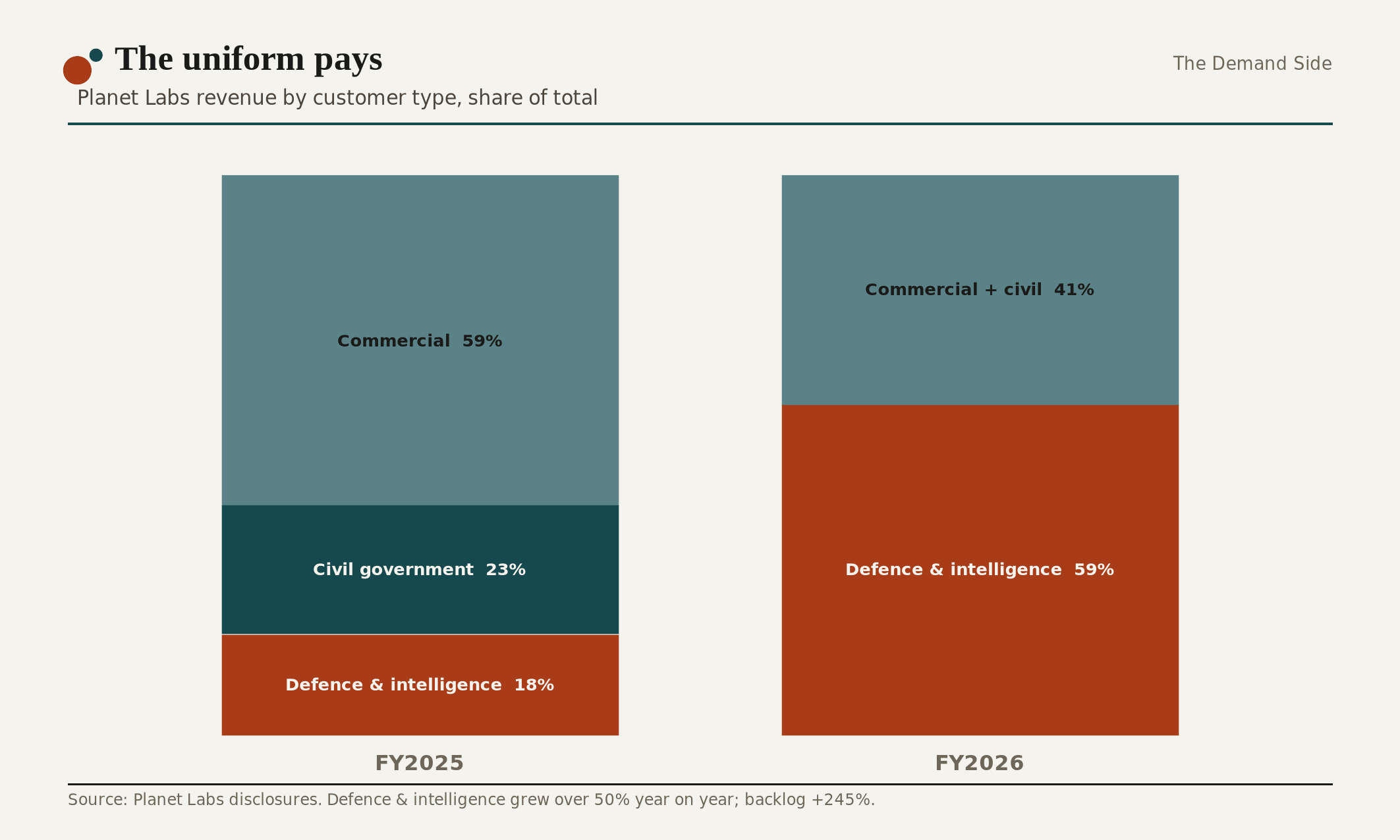
Chart 2. Planet Labs' revenue mix reorganised around defence and intelligence within a single fiscal year. FY2026 commercial and civil shares were disclosed jointly.
Varda and Firefly: new categories, familiar bridges
The youngest cohort repeats the sequence. Varda Space Industries pitches a genuinely new commercial category, pharmaceutical processing in microgravity, and funds the interim with a $60 million Strategic Funding Increase through the US Space Force's SpaceWERX pipeline, structured as $30 million of public money contingent on $30 million of matched private capital, plus a $48 million Air Force Research Laboratory contract that uses the same reentry capsules as hypersonic test platforms. Firefly Aerospace, celebrated in early 2025 for the first fully successful commercial Moon landing, flew that mission under a NASA Commercial Lunar Payload Services task order of roughly $93 million, and had already demonstrated 24-hour responsive launch for the US Space Force under the Victus Nox mission. In both companies the commercial story is real, and the manifest that keeps the hardware flying is written largely in government ink.
Rocket Lab and Axiom: pattern confirmation
Published research on Rocket Lab's emergence from New Zealand documents how agency demand and cultivated government relationships turned a small-country startup into a global launch company (Borroz and Korber, 2026). Axiom Space, marketed as the first commercial space station venture, rests on a NASA port award and NASA-brokered access to the International Space Station, and has sold its private astronaut missions chiefly to national governments. Across every case the sequence repeats: a public buyer underwrites the decisive step, and entrepreneurial execution compounds from there. Table 1 collects the pattern.
Table 1. The brand story and the government landmarks.
| Company | The brand story | The government landmarks |
|---|---|---|
| Iridium | Satellite phones for everyone | Rescued from liquidation by a DoD unlimited-use gateway contract (2000); EMSS renewal $738.5m over seven years (2019) |
| SpaceX | Reusable rockets for Mars settlement | COTS $278m (2006); CRS $1.6bn (2008); Commercial Crew $2.6bn (2014); NRO Starshield ~$1.8bn (2021); >$20bn cumulative federal awards |
| Planet Labs | Democratised daily Earth imagery | 59% of FY2026 revenue from defence & intelligence; backlog +245% on DoD, Germany, NATO; NRO EOCL subscription (2022) |
| Varda | Pharmaceuticals made in microgravity | $60m STRATFI via SpaceWERX; $48m AFRL hypersonic reentry testing |
| Firefly | Commercial Moon deliveries | NASA CLPS task order ~$93m (first successful commercial lunar landing, 2025); Victus Nox responsive-launch mission for the US Space Force |
| Rocket Lab | A garage startup from New Zealand | Agency-anchored emergence; government relationships as decisive resource (Borroz & Korber, 2026) |
| Axiom Space | The first commercial space station | NASA ISS port award and NASA-brokered access; private astronaut missions sold chiefly to national governments |
Remove the government landmarks from these histories and rerun them. Iridium's constellation burns up in the atmosphere in 2000, as Motorola planned. SpaceX exhausts its capital in 2009. Planet remains a beloved, structurally unprofitable imagery provider. Firefly's lander waits for a commercial lunar-delivery market that has yet to place an order anywhere. The companies that survive the exercise look very little like the champions Europe is told to imitate.
3. How the American customer works
Whether governments should shape space markets stopped being an open question decades ago; both spacefaring superpowers shape them daily. The productive question concerns design. The American design, assembled half by intention and half by Cold War inheritance, has two load-bearing components.
Anchor tenancy: the state buys outcomes and leaves the upside
NASA's COTS programme, and the resupply and crew contracts that followed, changed what the agency purchased. Under traditional cost-plus contracting the government buys effort: hours, hardware and documentation, with overruns reimbursed. Under COTS the agency bought results. Payments were fixed, released against demonstrated milestones, and the supplier retained the intellectual property and the right to sell capacity to anyone else. Two consequences followed. Public money leveraged private money instead of replacing it, at roughly 1.4 private dollars per public dollar, because investors were underwriting a signed customer rather than a technology bet. And competition remained live: when Boeing received $4.2 billion for commercial crew against SpaceX's $2.6 billion and still delivered years later, the fixed-price structure kept the taxpayer's exposure to that failure capped. The design survives supplier failure. Input-financed programmes rarely do.
The model has since been institutionalised across an entire segment. In May 2022 the National Reconnaissance Office signed its Electro-Optical Commercial Layer contracts, the largest commercial imagery procurement in its history: ten-year subscription arrangements worth up to $3.24 billion for Maxar, up to $1.02 billion for BlackSky, and an undisclosed amount for Planet. The world's most demanding imagery customer chose to buy pictures the way a business buys software, by subscription, from competing commercial suppliers it deliberately keeps alive. That single procurement decision underwrites much of the American Earth-observation industry, and it has no European equivalent at any comparable scale.
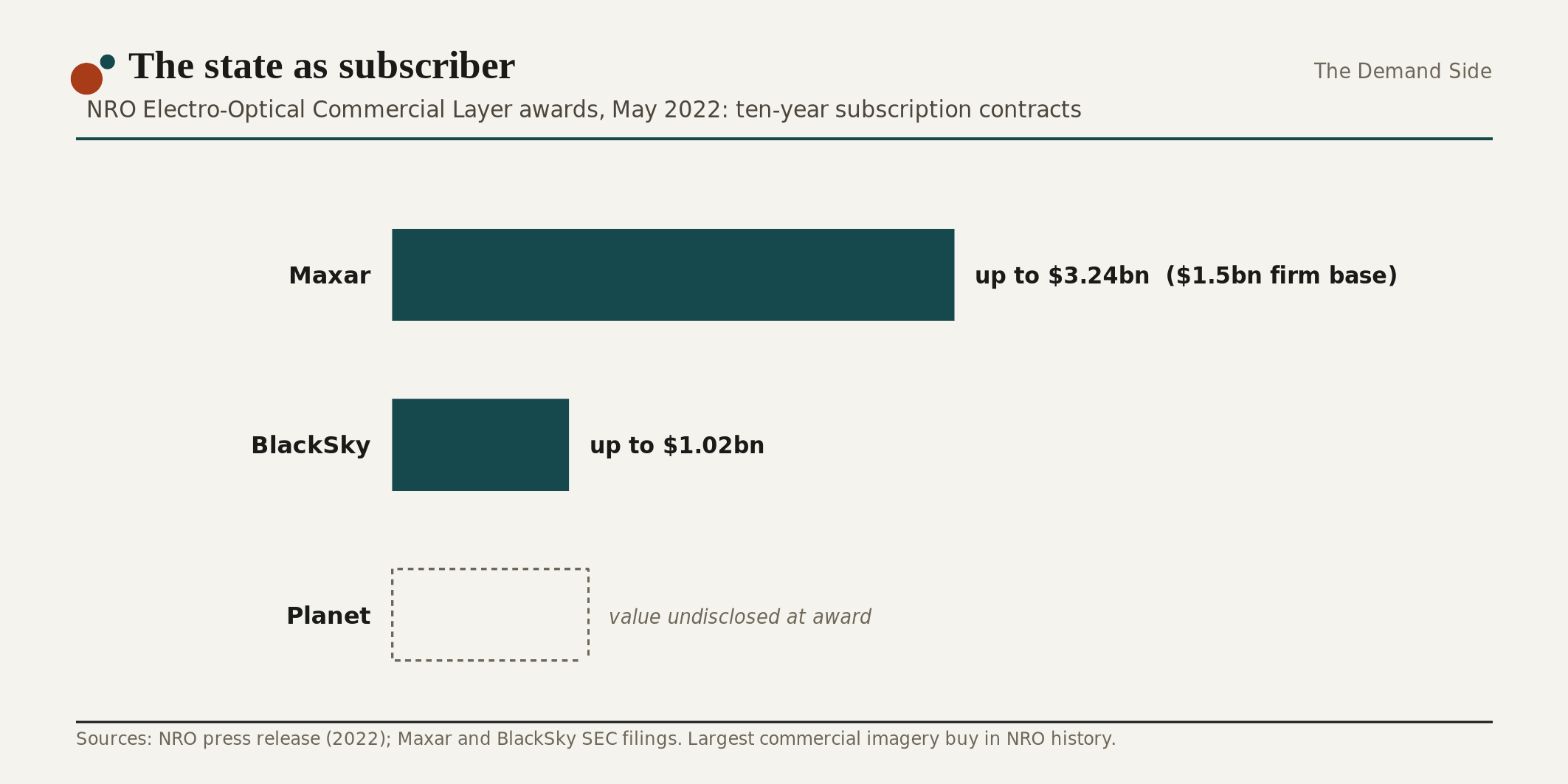
Chart 3. The NRO's EOCL awards put three commercial imagery providers on ten-year subscriptions. Anchor tenancy, operating at segment scale.
The defence premium: a buyer that pays for access
The second component recurs in every case in Section 2. Defence and intelligence customers buy differently from commercial ones, and from civil agencies. They pay a premium for guaranteed access and priority tasking. Their budgets renew annually by law and scale with geopolitics, which makes them the closest thing the industry has to recurring revenue with a sovereign guarantee. Iridium's rescue, Planet's revenue reorganisation and Starlink's Starshield spin-off all follow this demand curve; the premium customer reshapes the mix of whoever serves it well. A useful discipline for any analyst: before crediting a space company's growth to the free market, check which share of that growth renews by appropriation.
Free-market branding, procurement machinery
The United States is routinely presented as the laissez-faire benchmark, and in regulatory philosophy it often is: licensing is fast, experimentation is permissionless by comparison, and failure carries little stigma. The commercial layer of American space is real and impressively competitive. Underneath it, the military-industrial complex operates on principles a market economist would struggle to recognise: a single dominant buyer, decades-long relationships, classification as a barrier to entry, and procurement wielded openly as industrial strategy. The garages queue for federal paperwork precisely because the paperwork leads to the deepest demand pool in the industry. American entrepreneurship deserves its reputation. It operates, however, inside the best-funded demand architecture ever built for this sector, and its successes are joint products of both.
4. The transatlantic ledger
Set the two public customers side by side and the scale of the asymmetry becomes measurable.
Scale and composition
Europe's consolidated public space budget reached about €12.6 billion in 2024, growing 2 percent in a year. The United States government spent roughly $79.7 billion, around six times more, within a global public total of $135 billion that grew 10 percent, with defence supplying most of the growth. Composition separates the two customers as sharply as size. Some 88 percent of Europe's public space budget funds civil programmes, which concentrates European demand precisely where premiums are thin, renewal is political rather than statutory, and volume purchasing is rare. America's public customer is bigger, and it buys more of what builds companies.
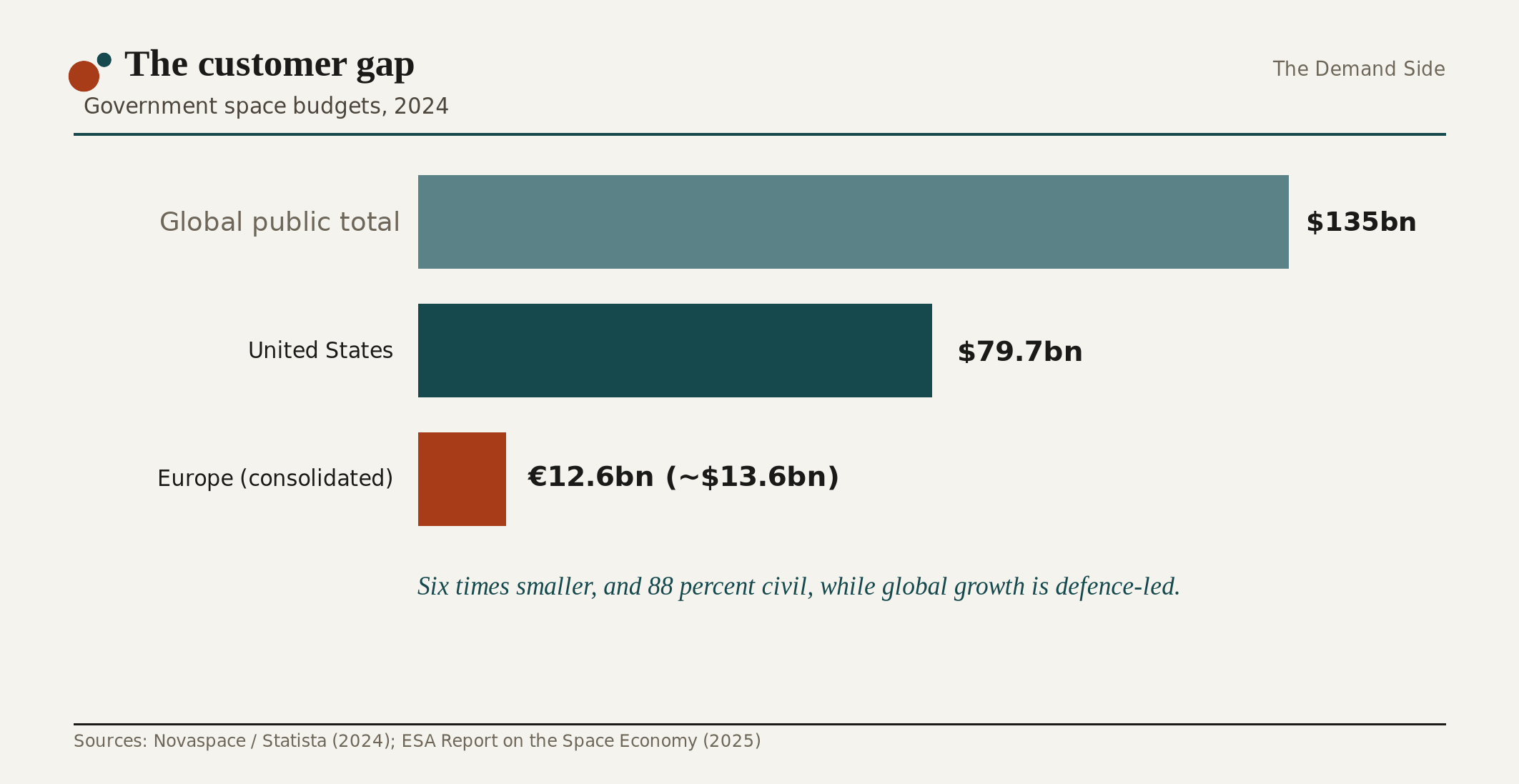
Chart 4. Government space budgets, 2024. Europe's public customer is smaller and buys different things.
The capital excuse is expiring
For a decade the standard account of Europe's lag centred on money: venture capital was scarce, exits were rare, and the ambitious went to California. The account has aged badly. European space ventures raised a record €1.5 billion in 2024, an increase of 56 percent in a single year, and the continent's share of global private space investment rose from roughly 3 percent in 2019 to 22 percent in 2024. Genuine weaknesses remain in European capital markets: abundant household savings routed into low-risk assets, and markets fragmented along national lines (Draghi, 2024). Late-stage rounds still lean on American funds. Yet the trajectory is unambiguous, and it strips cover from the older story. As the input constraint relaxes, the output constraint stands exposed: firms can increasingly find money, and still cannot find customers.
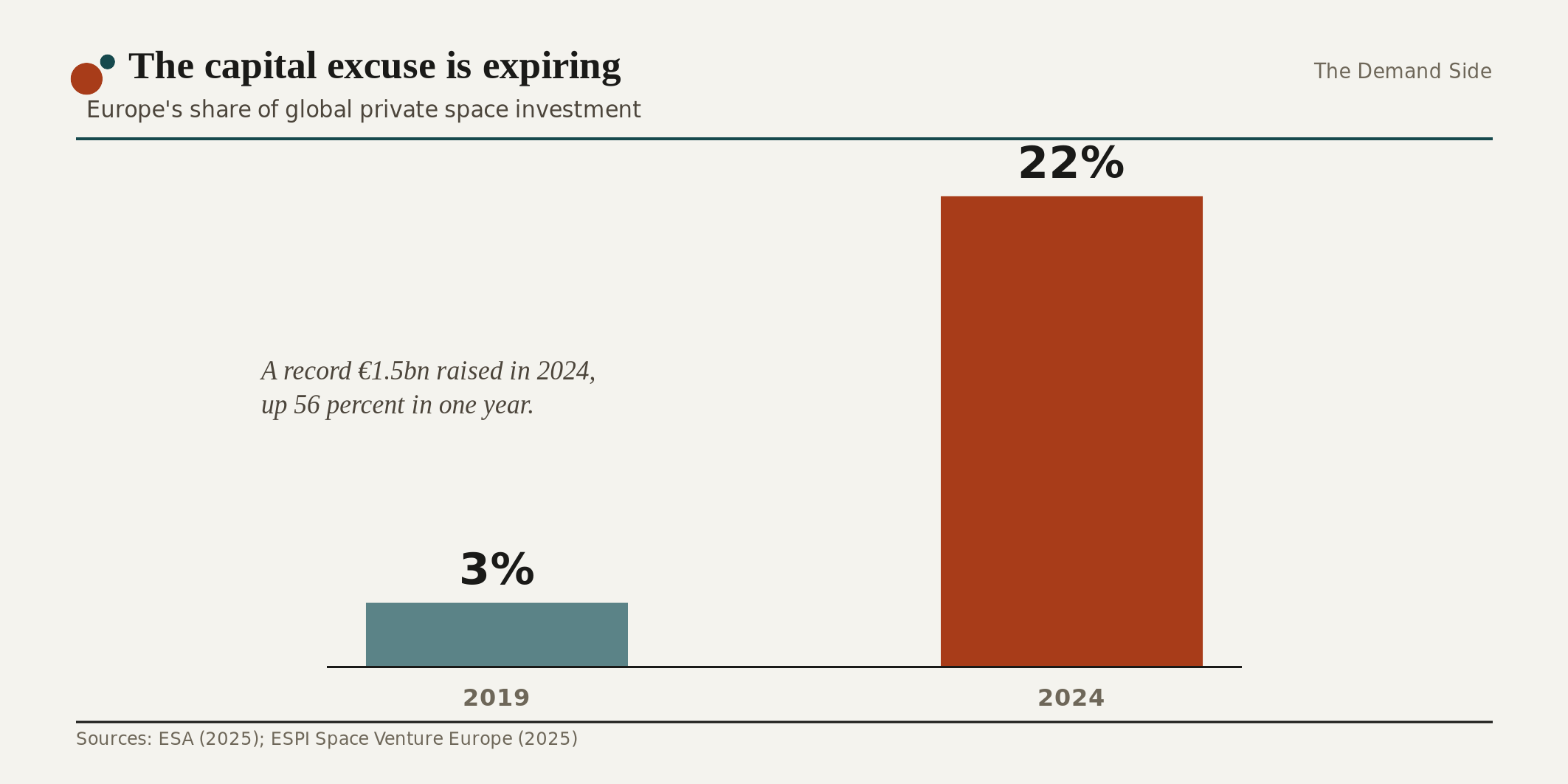
Chart 5. Europe's share of global private space investment, 2019 versus 2024. The input side of the ledger is repairing itself.
5. How Europe buys
Geographic return: politics as procurement
ESA's industrial policy rests on geographic return: each member state expects industrial work roughly proportional to its financial contribution. As a mechanism for sustaining political support across twenty-plus capitals, it has few rivals, and it has kept European space cooperation intact for half a century. As market-making, it inverts the American design. Contracts specify inputs, because inputs can be distributed; work packages scatter across borders, because distribution is the point; and programmes fund development without committing anyone to purchase the result. The output is a procurement tradition that reliably produces capabilities, and just as reliably declines to produce their first market. ESA has now quantified the result itself: its 2026 Space Economy Report puts institutional demand, dominated by defence, at roughly 80 percent of the upstream market, while the far larger downstream market runs largely on commercial revenue (ESA, 2026).
Fragmentation, at every level
European public demand also arrives divided. More than twenty national buyers, each with security sensitivities and a preference for domestic suppliers, slice continental demand into parcels too small to standardise against. No lead market forms, so no European firm can do what American firms do routinely: build once, certify once, and sell the same product to one large customer for years. The pattern repeats at ecosystem level, where public actors provide land, infrastructure and support in parts, through separate agencies with separate mandates, leaving companies to assemble their public relationships piecewise. A European founder deals with a dozen partial counterparts; an American competitor deals with an anchor customer. Even when the money is large, it does not trickle. Public funding concentrates in the established integrators, Europe's designated champions, and champions have every incentive to keep new work in-house: a start-up supplier carries bankruptcy risk and foreign-takeover risk that no procurement officer wants to own. Funding the champions and growing the start-ups are, in other words, different policies that Europe often treats as one. Europe has done the opposite once, and it worked. The Galileo procurement was structured with two primes rather than one: framework contracts went to both OHB and Astrium at the end of 2009, and OHB won the first work order for fourteen satellites. A supplier that had never built a navigation satellite became a prime, and the incumbent faced a competitor on price for the first time. Second-sourcing worked as market-making; trickle-down did not.
The exceptions test the rule
Two recent European moves suggest the lesson is landing. ESA's LEO Cargo Return Service explicitly imports the COTS structure: phased, milestone-based awards toward a purchased cargo service, with suppliers free to sell capacity elsewhere. IRIS², the EU's secure-connectivity constellation, was signed in late 2024 as a twelve-year concession with a private consortium, public money buying a service rather than owning a system. Both remain small next to the traditions they challenge, and both will be watched closely by everyone who wants the demand-side reading of Europe's problem confirmed or refuted. Their existence concedes the diagnosis.
One more observation belongs here, because it reframes the culture debate. Given this landscape, European founders behave exactly as economic theory predicts. American founders chase Pentagon and NASA order books, the biggest cheques in their room. European founders chase ESA development contracts, the biggest cheques in theirs. Identical entrepreneurship, responding rationally to differently designed demand.
6. Seven European firms under the same lens
Assertions about Europe's demand problem should survive contact with firm-level evidence. In the research underlying this edition, seven European NewSpace firms spanning the value chain were coded on public evidence across four dimensions: customer-base maturity, business-model repeatability, institutional dependence, and the strength of disclosed commercial evidence. The seven are ICEYE, Isar Aerospace, The Exploration Company, D-Orbit, Exotrail, Open Cosmos and ClearSpace. Three demand types structure the coding: institutional demand from civil agencies buying development work; strategic public or dual-use demand from defence and security buyers, which renews and scales; and commercial private demand for standardised products. Three results carry the argument.
The unit of sale decides the position
Proximity to commercial scale tracks business-model repeatability far more closely than the public or private identity of the first customer. Exotrail sells propulsion systems and D-Orbit sells in-orbit transport to many buyers; both remain partly dependent on institutional demand, and both nonetheless sit near the commercial-scaler position because each sale repeats. ClearSpace, backed by a prestigious ESA debris-removal award, delivers a bespoke, first-of-a-kind mission with the agency as effectively its only customer, and sits furthest from scale. Isar Aerospace, despite roughly €800 million raised, operates in a launch segment where non-institutional European buyers barely exist, and its position reflects the market more than the company. Customer badges carry little analytical information; units of sale carry a great deal.
ICEYE: the sequence that matters
ICEYE, the Finnish radar-imaging firm, offers Europe's cleanest demonstration of how the transition works. Revenue above €250 million in 2025, earned profitably. A €1.5 billion order backlog anchored by sovereign buyers. Its joint venture with Rheinmetall also won a €1.7 billion contract in December 2025 to serve the German armed forces; ICEYE's share was not disclosed. And in June 2026, a funding round above €1 billion at a valuation above €10 billion, the largest in European NewSpace history. The order of events deserves more attention than the amounts: demonstrated, recurring demand came first, and capital followed it. ICEYE's buyers remain overwhelmingly public. Their behaviour, repeat volume purchases of a standardised product, is what changed the company's trajectory. The escape, precisely described, was from bespoke, one-off, input-specified demand into recurring demand for a product, with the customer's public status left intact. It is Europe's own small-scale EOCL, assembled contract by contract instead of designed by a single buyer. It is tempting to read the transatlantic contrast as a difference in investor courage, American risk capital versus European caution. The contract records suggest otherwise: American investors also waited for the customer, at SpaceX as at Planet. What America supplies its founders is not braver money. It is an earlier customer.
Order books deserve a credit analyst's eye
The Exploration Company, Europe's commercial cargo hopeful, discloses roughly $770 million in contracts. About 90 percent of that figure comes from private space-station developers that are themselves pre-revenue, ventures whose own markets remain hypothetical. The backlog is real as a legal matter and conditional as an economic one; it describes demand expected, contingent on other companies' business plans succeeding first. A related habit compounds the measurement problem: in a sector where many investors cannot independently evaluate engineering claims, firms learn to perform commercial momentum through funding announcements and social channels. Signalling aimed at investors tells an analyst little about customers, one more reason funding totals make a poor proxy for demand. Reading order books the way a credit analyst reads collateral, asking what is committed, what is conditional, and who ultimately pays, separates Europe's genuine commercial progress from its well-financed waiting rooms.
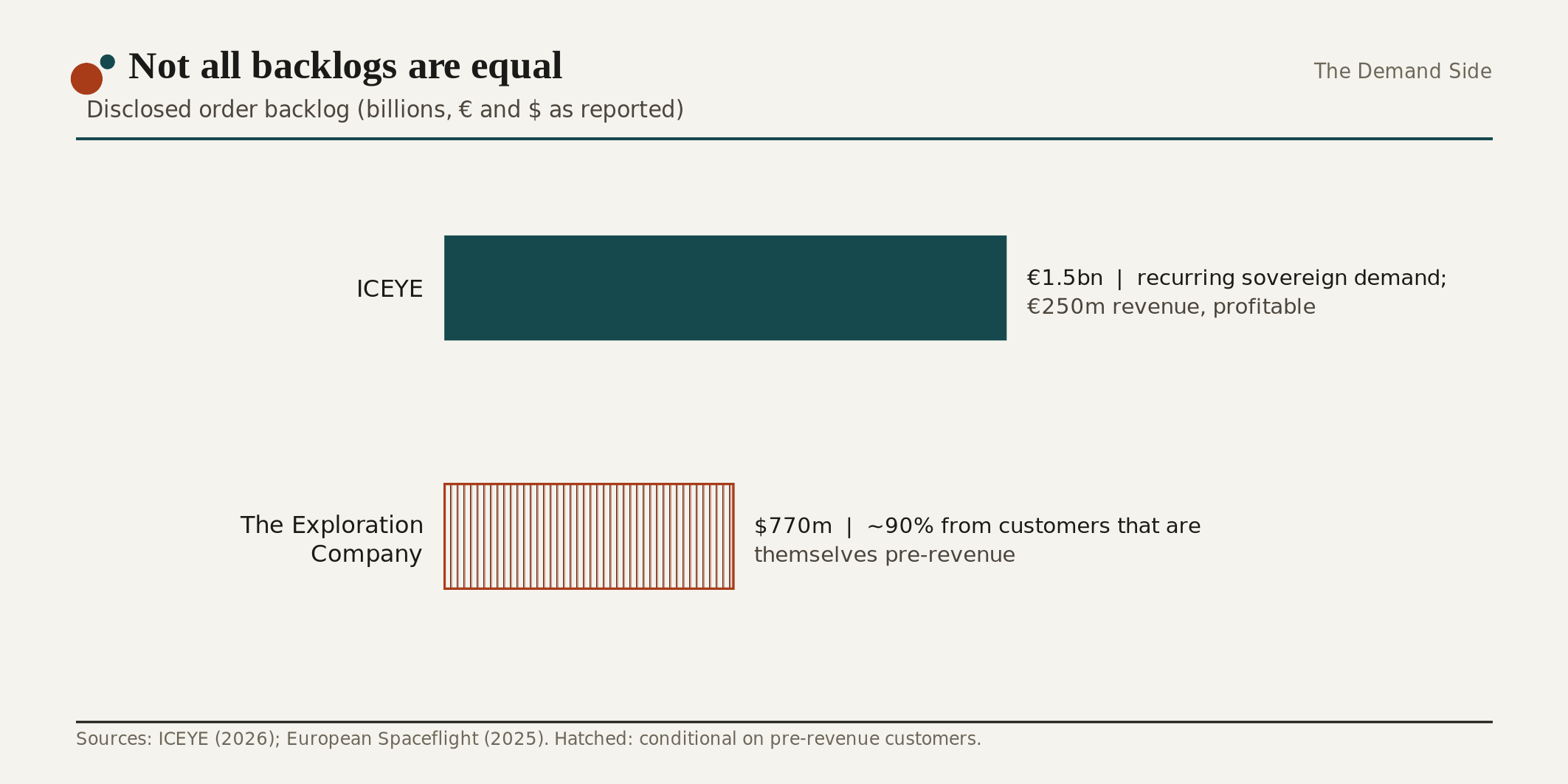
Chart 6. Two European backlogs. ICEYE's rests on recurring sovereign demand; The Exploration Company's rests, to roughly 90 percent, on customers that have yet to earn revenue.
Figure 1 places all seven firms on the two dimensions that define the transition out of institutional dependence.
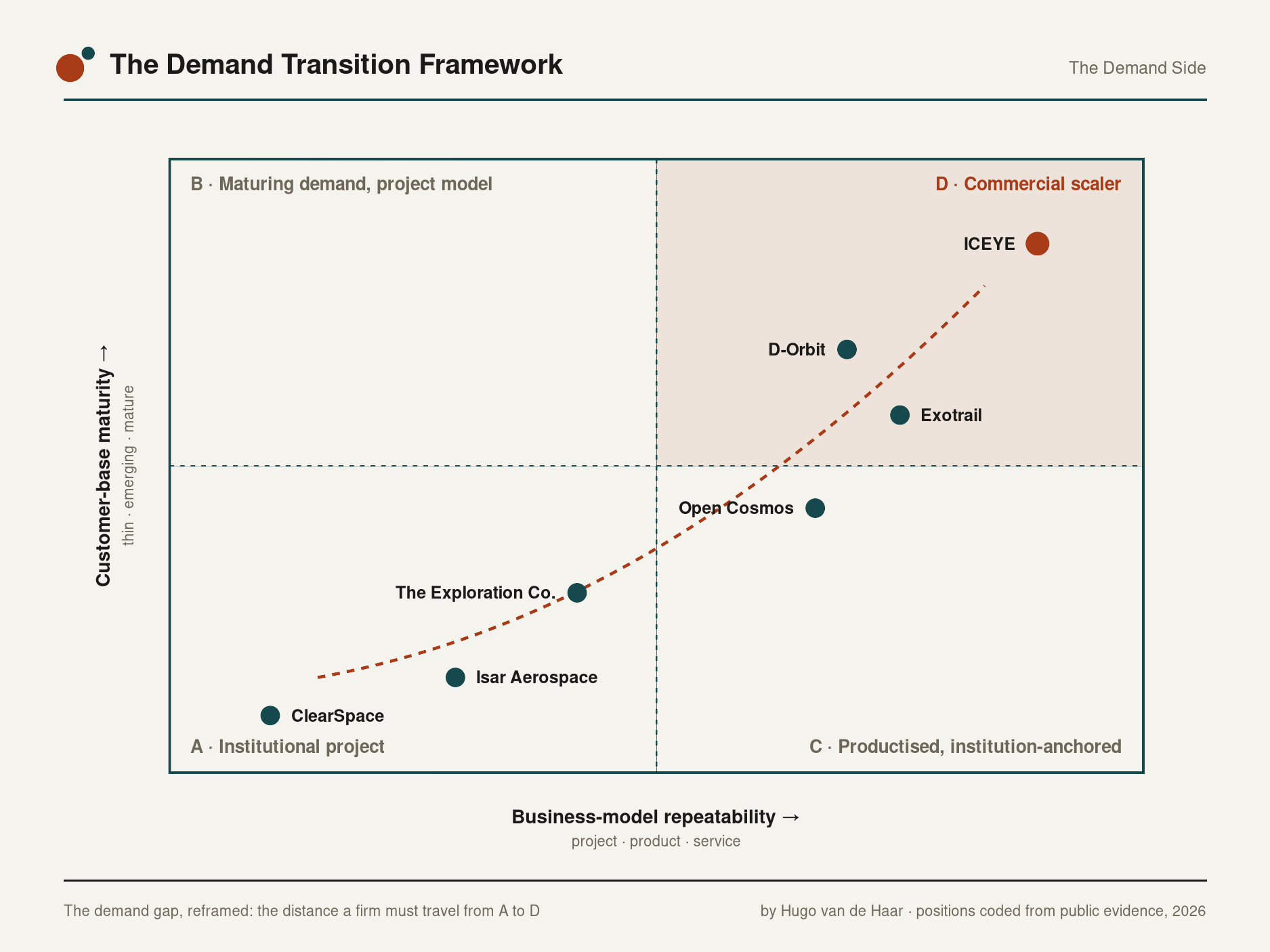
Figure 1. The Demand Transition Framework: firm positions by customer-base maturity and business-model repeatability. The shaded quadrant marks the commercially scalable position.
7. The strongest objection, taken seriously
One counterargument to everything above deserves a full hearing, because serious people in European space policy hold it, and because parts of it are right. It runs as follows. Governments fund space capability for strategic autonomy. They know a large share of the funded ventures will fail, and they fund them anyway, the way societies fund education: as a public provision maintained for what it enables rather than for its financial return. On this view, supply-push is a choice, and the absence of commercial demand around some capabilities signals nothing wrong.
The argument holds across a defined territory. Sovereign launch access, secure government communications, scientific missions, and Earth observation for public administration are legitimate public goods; nobody audits a lighthouse for product-market fit. The argument stops holding at a boundary that Europe's current funding wave keeps crossing: ventures positioned as commercial businesses, raising private capital and recruiting scarce engineering talent on the promise of markets, while operating indefinitely on institutional revenue. For that category, which now spans much of the sector's fundraising, repeatable customers constitute the binding constraint, and treating budgets as if they were markets postpones the reckoning at compounding cost. Distinguishing the two categories, infrastructure and enterprise, may be the single most valuable habit European space policy could adopt. Conflating them serves the interests of nobody except the ventures that would rather never be measured. A second objection lands from the opposite direction, and it now appears in print from the most senior levels of European space policy: the American model this edition describes is not only a procurement success but a monopoly machine. State financing and lucrative government contracts allowed SpaceX and Starlink to wipe out functioning markets, build monopolies and create dependencies that Europe today treats as existential risks (Schrogl, 2025). The warning deserves to shape the answer rather than block it. It argues not against the state as anchor customer, but for anchor tenancy with European characteristics: multiple awardees by design, second sources built deliberately, the OHB lesson applied from the start. Buying outcomes and preventing monopoly are not competing goals; the NRO already buys its imagery from three providers at once.
8. What follows
For policymakers: four moves
Buy outcomes at scale. Extend the LEO Cargo logic and the IRIS² structure to Earth observation, in-orbit servicing and space logistics: committed purchases at defined prices, suppliers keeping spare capacity. A European EOCL, ten-year imagery and data subscriptions across competing providers, would do more for the continent's Earth-observation sector than any development programme yet funded, and existing budgets become market-making budgets without an additional euro of spending.
Aggregate the demand. Pool member-state requirements into lead markets large enough to justify standardised products. The proposed EU Space Act is the available vehicle, and its test of seriousness is concentration of demand; harmonised paperwork alone leaves the parcels as small as before. Public administrations can reinforce the shift by buying space-enabled services as ordinary users, the way the American government buys commercial imagery by subscription.
Direct the defence wave. Security-linked demand already accounts for roughly 40 percent of recent European space fundraising, with more than €600 million flowing to defence-related ventures in 2024. Spent as input-financing, it reproduces the old pattern with a larger budget. Spent as anchor demand for standardised products, it becomes Europe's version of the mechanism documented in Section 3, and the ICEYE case shows the conversion working on European soil.
Measure customers, and publish the measurements. Capital raised, contracts awarded and technologies matured are input metrics. A public scoreboard of demand conversion, tracking which supported firms develop repeatable non-institutional revenue, would discipline both the spending and the storytelling around it.
For investors: three practices
Decompose every backlog into committed and conditional demand before crediting it. Discount signalling aimed at your own asset class; announcements of funding are evidence about funding. And price business-model repeatability as seriously as technological differentiation, because in this sector the second rarely monetises without the first.
For operators: two disciplines
Treat institutional contracts as reference customers and first revenue, and design the unit of sale for repetition from the outset: catalogue products, subscriptions, standardised service tiers. And when dual-use demand arrives, bank the scale, then deliberately convert it into adjacent civilian markets, in insurance, agriculture, energy and logistics, before the budget cycle turns. Dependence on one public buyer, however generous, remains dependence.
9. The scoreboard, and what comes next
The measurement gap identified above is the founding purpose of this publication. The Demand Side examines European space and deep-tech companies through the question that predicts survival better than any funding announcement: who is buying, at what quality of commitment, and will they buy again? Each assessment applies the coding used in Section 6, so that over time the individual analyses accumulate into a comparable dataset: a traction scoreboard for the European space economy.
The next edition applies the framework to Europe's launch segment, where public money is most concentrated, commercial demand is thinnest, and the gap between funding narratives and customer evidence is at its widest. If the argument of this first edition is sound, the results will be uncomfortable. Measurement usually is.
Method, sources and disclosure
This study builds on the author's coded multiple-case study of seven European NewSpace firms based exclusively on public evidence, and on conversations with operators, regulators and analysts across the European and US space sectors, used here without attribution. All figures derive from disclosed, citable sources; where a contract is classified (the NRO constellation), values are as reported by major outlets and are marked accordingly. Currency figures are stated as disclosed, without conversion, except where noted.
Principal sources: NASA COTS, CRS and Commercial Crew award records; NRO press release and Maxar/BlackSky SEC filings on the Electro-Optical Commercial Layer awards (2022); Iridium bankruptcy and DoD EMSS contract history, including the 2019 seven-year renewal; Planet Labs FY2025 and FY2026 disclosures and earnings coverage; public reporting on SpaceX's NRO contract and cumulative federal awards; SpaceNews and Aviation Week reporting on Varda's STRATFI and AFRL awards; NASA CLPS task-order records and coverage of Firefly's Blue Ghost landing (2025); Borroz, N. and Korber, S. (2026), teaching case on Rocket Lab, International Journal of Entrepreneurship and Innovation; Novaspace and Statista, government space budgets 2024; ESA Report on the Space Economy (2025); ESPI, Space Venture Europe (2025); Draghi, The Future of European Competitiveness (2024); European Commission, proposal for an EU Space Act (2025); ICEYE financial disclosures (2026) and Rheinmetall (2025) on the German SAR joint venture; European Spaceflight (2025) on The Exploration Company's contract composition. Schrogl, K.-U. (2025), Raumfahrt als Staatsaufgabe, Internationale Politik, November/December 2025, on the return of space as a state task and the monopoly risks of the American model. ESA, Report on the Space Economy 2026, on the institutional share of upstream demand and the commercial weight of the downstream market.
Corrections, 17 October 2026
The ICEYE paragraph now distinguishes the order backlog from the joint-venture contract. The reading guide points to the correct sections. The executive summary describes the NRO contract ceilings rather than an incorrect upper bound. The study's data window is unchanged.
The reading page and downloadable PDF are version 1.1. The original version remains in the DOI archive.
The Demand Side is an independent analysis of demand in the European space and deep-tech economy, written by Hugo van de Haar. Corrections, criticism and disagreement are welcome at hugo@vandehaar.com. What changes a figure is corrected in the open.
Edition 001, 15 pages. Published under CC BY-NC-ND 4.0: free to share with attribution, unchanged and non-commercially.
Original version archived with a DOI: 10.5281/zenodo.21609171. Cite as: van de Haar, H. (2026). The Best Customer on Earth. The Demand Side, Edition 001, version 1.1 (corrected 17 October 2026). https://hugovandehaar.com/edition-001.html
Next edition: 002 · The Missing Customer
One email when a new edition is out.
I only use this list to send new editions. How your email address is used.