I help engineering-led companies work out who buys what they build, and say it in a way those buyers recognise. The research behind it runs on public sources, with the counting rules published alongside.
Positioning is a commercial question before it is a design one.
Which is why the work starts with your market, and not with your homepage.
Week one is a demand-side read of your own market: who actually buys what you build, for which decision, and what they need to believe first. What comes out is a positioning and a messaging hierarchy your whole team can use.
Only then does it land anywhere. The site is one surface. The executive profiles are another, and for early-stage companies often the one that moves first. The one-pager is what gets forwarded inside a customer or a fund when you are not in the room.
If what you want is a website, there are good studios for that. This is the question underneath it, and the reason the answer is worth writing down.
Four hours of your time across the three weeks. Fixed price, and week one is invoiced separately so you can stop there.
The sector celebrates funding rounds while the harder question goes unasked: who is the customer, and for which decision are they paying?
Europe has no shortage of technology or capital. Buyers are scarcer. That gap is measurable, and it is what I study.
The first figure is ESA's. The other two are my own counts, and every site behind them is open to inspect.
Commercial means the roles whose job is to find a customer: sales, business development, marketing, partnerships, bids. For each one of those, 7.7 engineering vacancies were open beside it.
Counted from public job boards on 23 July 2026, one snapshot of a market that moves daily. Counting rules and the company list in Research & method.
9.2%of open positions in European space are commercial roles
Europe is well served for market sizing and funding data. What I could not find was anyone measuring, company by company, whether the demand is actually there. So I built the measurements I needed, on public sources, with the counting rules printed alongside. Each one reads the same gap from a different side.
105company websites, 98 readable, July 2026
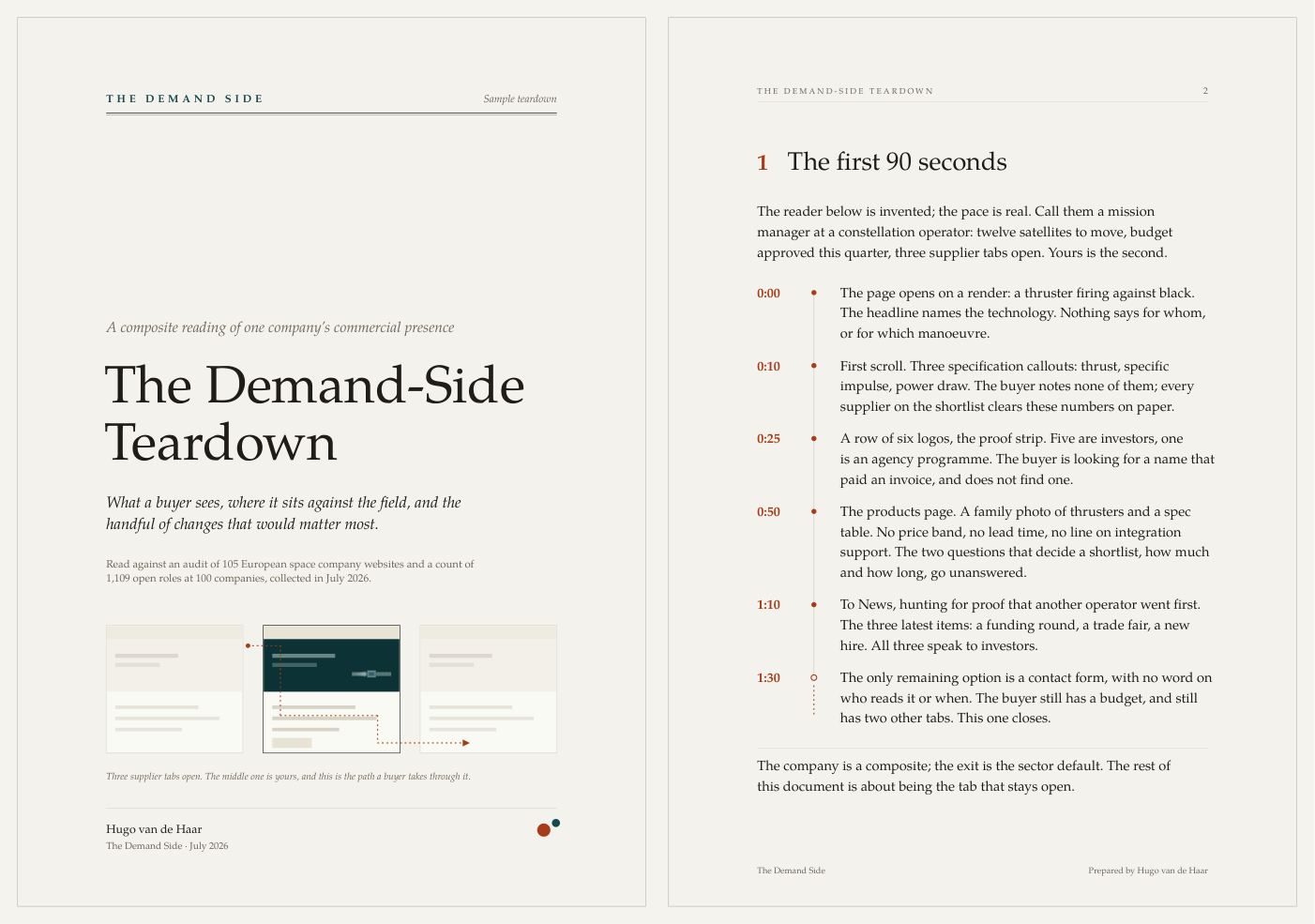
Six questions a buyer asks, coded on every homepage. Half name a paying customer, and half of those name a public one. For 58 of the 98, a contact form is the only thing you can do. It is a proxy for commercial legibility, and a cheap one to move. Open the field.
1,109open positions across 100 companies
Hiring is a budget decision, so a job board says more than a press release. Commercial roles are 102 of those 1,109, and the commercial titles skew hard towards bids, capture and defence. The index is recomputed each quarter on a fixed list. See the method.
7firms coded in depth, on two axes
The Demand Transition Framework maps the distance from one-off systems for agencies to repeatable revenue from commercial buyers, and the two routes across. It is a diagnostic drawn from cases, not a validated model, and it supports claims about sequence and position rather than cause. Work through it.
Together they are the beginning of a longer record of who buys and whether the buying repeats. That record is the point, and it takes quarters rather than weeks to build.
Version 2, July 2026. The hiring index is recomputed each quarter. The website audit is re-run when the sample changes. Where a count is revised, the correction is published with it rather than folded in quietly.
A demand-side teardown, a three-week Commercial Presence Sprint, or a standing role as the person who keeps your positioning in step with the market. Fixed prices, two sprint slots a quarter.
The Demand Transition Framework, the Commercial Hiring Index, and the counting rules behind both. How I work out who is winning real customers rather than the next grant.
Independent analysis of who actually buys in European space. Published when it's ready to hold up; first edition August 2026.
One of the three instruments, published in full: 98 readable company websites coded on the six questions a buyer asks, sortable by segment and country.
Free tool: score your own site against the same six questions, and see where it lands against the field.