Every satellite European operators sent to orbit since 2023, traced to the rocket that carried it.
Get one email when a new edition is out
In this edition
- Executive summary
- 1. The segment where the argument meets its test
- 2. Where Europe's satellites actually flew
- 3. The order book: a monoculture with one exception
- 4. Where the demand lands instead
- 5. How the American customer buys launch
- 6. The new generation: contracts before flight
- 7. The buyer Europe is starting to build
- 8. The vacancy signal
- 9. What would change this reading
- Method, sources and disclosure
Executive summary
Europe's launch debate is a supply debate. It argues about vehicles, budgets and sovereignty, and it rests on a shared assumption: the problem sits on the pad, and once Europe builds a better rocket, the market will follow. This edition started at the other end and followed the customers. Every satellite launched for a European operator between 1 January 2023 and 7 August 2026 has been traced through the public launch manifests to the rocket that carried it and the place it left Earth. The count comes to 643 satellites.
The customers were somewhere else.
European commercial operators launched 475 satellites in the window. Four of them went up on a European vehicle: 0.8 percent, all four as cubesat rideshares in 2023 and 2024, none as a primary payload, and none at all after the Ariane 6 demonstration flight of July 2024. Of all 643 satellites European operators launched, 34 flew on a European rocket, 5.3 percent, and 82.6 percent flew on a Falcon 9 or Falcon Heavy. Eleven times as many European satellites left Earth from one Falcon 9 pad on the California coast as from Europe's own spaceport in French Guiana.
Behind that outcome sits an order book with one commercial anchor. Of the roughly thirty flights in the order book Arianespace described in mid-2024, eighteen belonged to Amazon under a single contract signed in April 2022, and nearly all the rest were European institutions. The most recent new framework agreement with a European commercial operator of geostationary satellites dates to 2018. In December 2025 the company was recapitalised, and member states have committed up to €340 million a year so the rocket can operate at all.
The difference turned up in how America buys. Its public buyers purchase launch the way a business buys freight: recurring framework competitions with dates, and mission orders assigned against fixed prices every fiscal year, deliberately spread across several suppliers. NASA has bought 64 space-station cargo flights since 2008 from the same recurring suppliers; the National Reconnaissance Office launched fourteen missions of one reconnaissance programme in twenty-five months. The size gap tracks the budget gap the first edition recorded: in 2025, European institutions bought six flown launches, while the US Space Force alone assigned sixteen Lane 2 missions and awarded $13.7 billion in that lane. In July 2026 it tripled the ceiling of the other lane, the open one for newer vehicles, to $17 billion.
Europe's own new rockets change none of this by themselves. The seven new launch ventures had, as this edition closed on 8 August 2026, delivered zero paid orbital missions; every order in that generation is a pre-flight order, and repeat purchasing cannot exist yet, because nothing has been delivered to repeat.
Europe has started, late, to build the missing customer. The Flight Ticket Initiative has bought seven missions across three providers since August 2025. The European Launcher Challenge drew €902.16 million in member-state subscriptions; of that, about €276 million sits in Component A, the part that buys launch services from 2026 to 2030, and about €509 million in Component B, which co-funds capacity upgrades. On 27 August 2026, ESA signed the first contracts under it: €197.8 million for Isar Aerospace, €186.9 million for Rocket Factory Augsburg and €158.9 million for PLD Space. The buying only starts once a company has reached orbit, and the deadline for that is the end of 2027; none of the three is there yet. IRIS², the largest demand block on Europe's horizon, carries a declared European preference and is heading toward negotiated allocation rather than open competition. The direction is the American one. Whether the money becomes purchases now rests on three rockets reaching orbit before the end of 2027.
The European Launcher Challenge is the first test, at scale, of whether the constraint this edition measures is being lifted. That constraint is not the supply of rockets. It is the absence of customers who buy launch repeatedly, and of the machinery that creates them.
1. The segment where the argument meets its test
Launch is where Europe's supply-side tradition shows in its purest form. Few segments concentrate so much public money and so much national pride in so few companies, and few have thinner commercial demand to meet it. The first edition argued that Europe's space problem is best read from the demand side, through the question of who buys, at what quality of commitment, and whether they buy again. If that reading is sound anywhere, it must be sound here.
Launch is also where the argument is hardest to defend. Sovereign access to orbit is a public good; a continent that cannot lift its own satellites depends on the goodwill of whoever can. This edition does not dispute that, and section 7 returns to it. The narrower matter is this: given three decades of public investment in supply, where does the demand actually go, and what would have to change before Europe's rockets, old or new, could live on customers rather than appropriations. Europe's new launch companies employ serious engineers doing difficult work, and nothing below is a verdict on any team. This edition looks at order books, procurement mechanisms and the behaviour of buyers.
Three kinds of public money reach a launch company, and the debate routinely treats them as one.
Sponsorship
pays a company, so that a capability exists.
Procurement
pays for a mission the buyer needs.
Market demand
pays for a service the buyer needs again.
Only the third creates a customer who comes back.
Most of the public money in this count sits in the first two.
2. Where Europe's satellites actually flew
What I could not find was a published source that answered a simple question: of the satellites European operators have launched since January 2023, how many flew on a European rocket? BryceTech counts launches globally; ESPI does not publish this split. The manifests, however, are public. So this edition counted them: every free-flying satellite of an operator headquartered in the EU, the United Kingdom, Norway or Switzerland, launched between 1 January 2023 and 7 August 2026, each satellite with the source that confirms it. The total came to 643. Anyone can recount them.
Of the 475 satellites of commercial European operators, four flew on a European rocket: 0.8 percent, all four as cubesat rideshares on a Vega flight in October 2023 and on the Ariane 6 demonstration flight in July 2024, none as a primary payload, and none since.
Of all 643 satellites European operators launched in those forty-three months, 5.3 percent flew on a European rocket. 82.6 percent flew on a Falcon 9 or Falcon Heavy.
Even institutional Europe flew mostly American: of 103 satellites of European agencies, governments and public bodies, 75 went up on a Falcon 9 and 22 on a European vehicle.
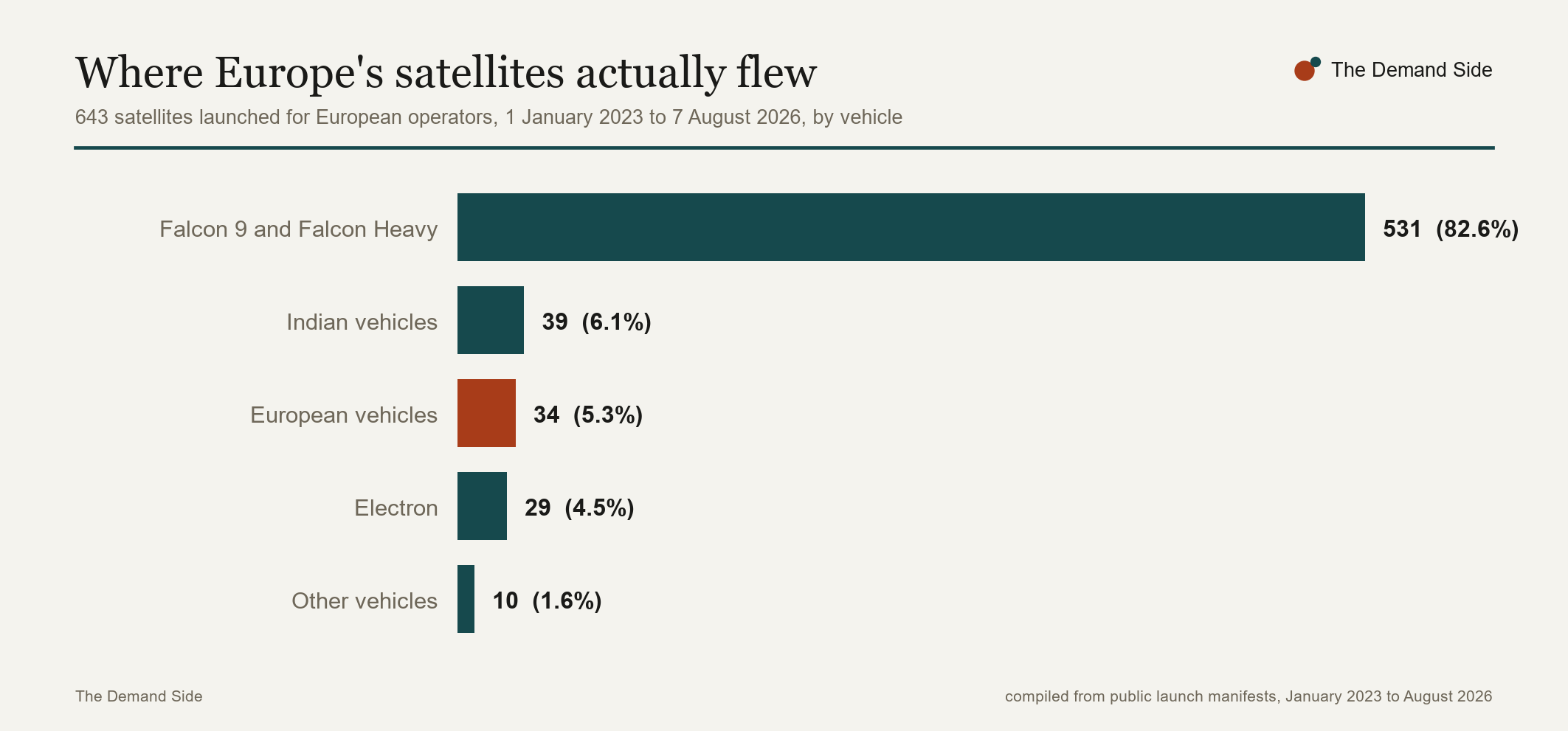
Chart 1. Satellites launched for European operators, 1 January 2023 to 7 August 2026, by vehicle. The European bar is the story.
By year: 13 of 263 satellites on European vehicles in 2023, 9 of 114 in 2024, 11 of 158 in 2025, and 1 of 108 in 2026, a part-year of seven months, up to the window's close on 7 August. By operator type, commercial operators are the extreme case, at 85 percent on Falcon vehicles and under 1 percent European; academic operators sent 55 of their 65 satellites up on American rockets; institutions, as above, bought European for less than a quarter of their satellites.
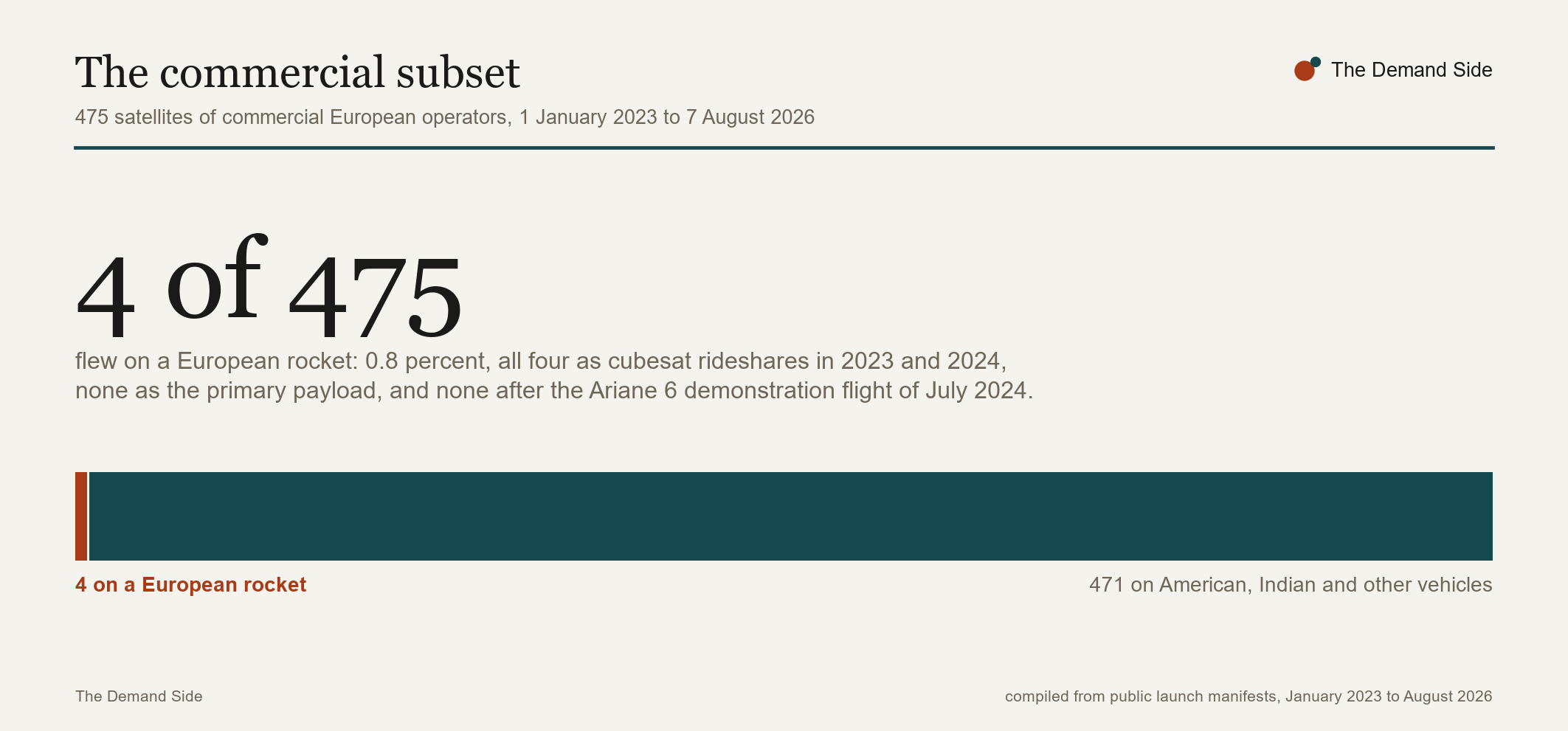
Chart 2. The commercial subset. Four of the 475 satellites of commercial European operators flew on a European rocket, none of them as a primary payload.
Put the 643 satellites on a map by the place they left Earth, and Europe's spaceport in French Guiana nearly vanishes: 34 satellites in forty-three months. SpaceX's single Falcon 9 pad on the California coast sent up 395, eleven times as many. Cape Canaveral and the neighbouring Kennedy Space Center sent up 137. Sriharikota, India's spaceport, launched more European satellites than Kourou did, 39 against 34, most of them a single OneWeb batch of 36; Rocket Lab's launch site on New Zealand's Māhia Peninsula came within five of Kourou's total. In all, 532 of the 643, more than four in five, left from American soil. The only other satellites to leave from a European site, six on the air-launched flight out of Cornwall in January 2023, were lost when that launch failed. Counted by mission rather than by satellite, the picture softens but does not turn: 13 of the 74 launches that carried European satellites lifted off from Kourou, 17.6 percent, and on that unit Europe flew more launches than the Transporter line did, 13 against 12. Neither unit is the whole answer; both are here.
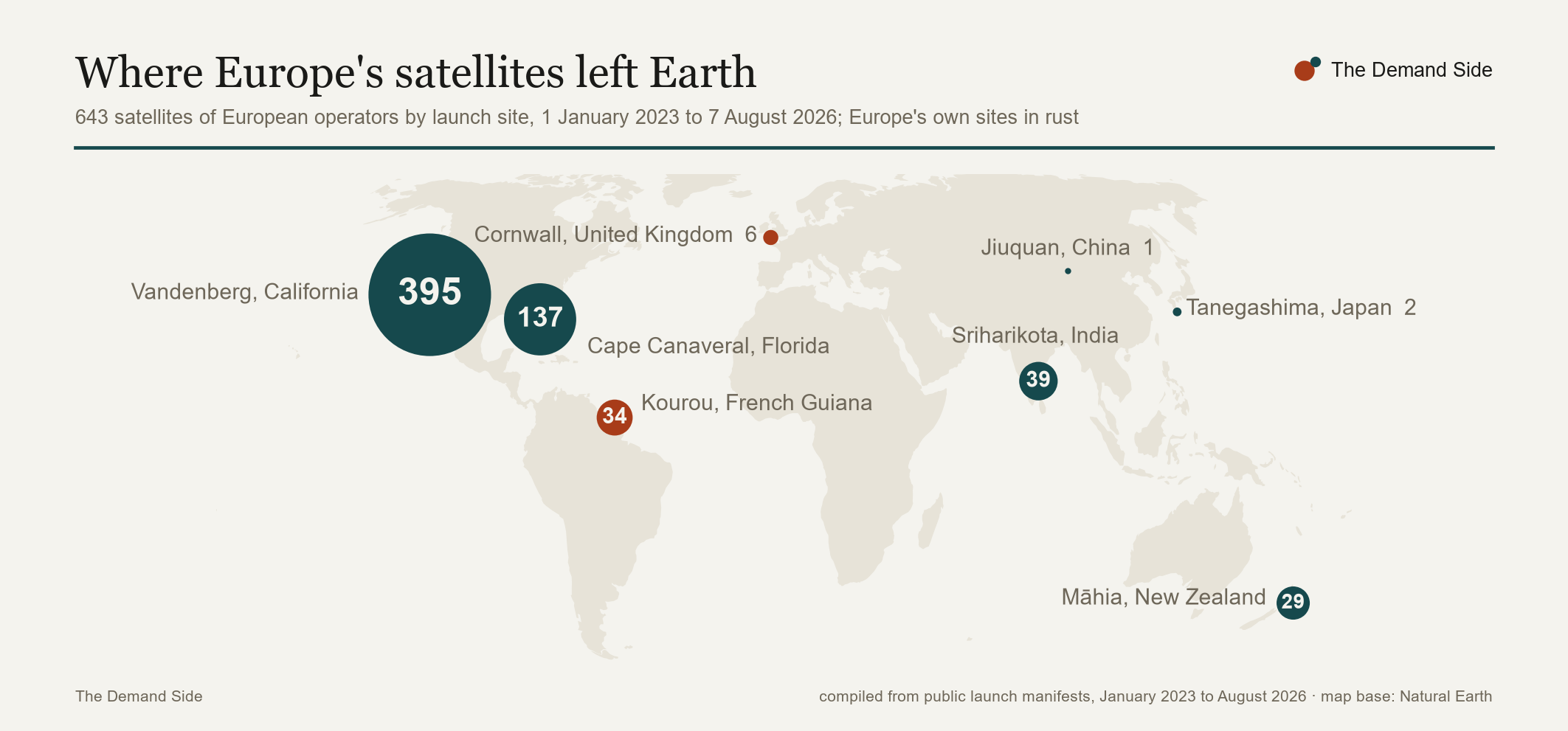
Map 1. Where the 643 satellites left Earth. Circle areas are proportional to the number of satellites; Europe's own sites are in rust. The Cape Canaveral circle includes the adjacent Kennedy Space Center pads.
Table 1. Where 643 satellites of European operators flew, by vehicle.
| Vehicle | Satellites | Share |
|---|---|---|
| European vehicles (Ariane 5 and 6, Vega and Vega-C) | 34 | 5.3% |
| Falcon 9 and Falcon Heavy, Transporter rideshare | 336 | 52.3% |
| Falcon 9 and Falcon Heavy, dedicated | 150 | 23.3% |
| Falcon 9 and Falcon Heavy, other rideshare | 39 | 6.1% |
| Falcon 9 and Falcon Heavy, Bandwagon rideshare | 6 | 0.9% |
| Falcon 9 and Falcon Heavy, all routes | 531 | 82.6% |
| Electron | 29 | 4.5% |
| Indian vehicles (LVM3, PSLV) | 39 | 6.1% |
| Japanese vehicles (H3) | 2 | 0.3% |
| Chinese vehicles (Kinetica-1; the launch failed) | 1 | 0.2% |
| Other (LauncherOne, SLS) | 7 | 1.1% |
| All vehicles | 643 | 100.0% |
A satellite is not a purchase: a constellation batch of 36 is one buying decision recorded 36 times, and more than half of this total travelled as rideshare. Small satellites dominate the numbers, while the 34 satellites on European vehicles include heavy institutional missions that no rideshare could carry. The totals say where European payloads went, launch slot by launch slot; they do not say how many contracts, kilograms or euros went with them, and no claim below pretends otherwise.
How the satellites were counted. The unit is the free-flying satellite; instruments riding attached to someone else's satellite are not in. The operator counts, not the builder, because the operator bought the launch, and the purchase is the demand signal. An operator belongs in this edition when its group headquarters sits in the EU, the United Kingdom, Norway or Switzerland; ESA, EUMETSAT and EU bodies count as European institutions; a subsidiary counts under its parent. Every satellite appears once, with its operator, launch date, rocket, launch site and a source anyone can open; a constellation batch on one launch is recorded together when the source states the number. Failed launches count, with a note, because the ride was bought and the satellite flew. Transfer vehicles count as satellites of their operators, and the satellites they later release count too, on the rocket that took them up. Satellites deployed from the International Space Station count on the vehicle that carried them there. Whatever could not be pinned to a source was left out, with the sources tried on record. The window is 1 January 2023 to 7 August 2026, and it stays shut: a launch after 7 August belongs to the next edition, not to a quiet revision of this one. One check remains before publication, and the cover says so: the author verifying a random handful of satellites against their sources by hand.
The window matters for one live case. It closed on 7 August 2026; the first candidate European launch after that date, the first flight of RFA ONE from SaxaVord, had a window opening three days later, and the vehicle was taken off the pad for inspection before that window opened. Whatever happens there belongs to the next edition's numbers; these do not get revised silently.
3. The order book: a monoculture with one exception
Until February 2026, and for more than three years, not one commercial primary payload, of any nationality, flew on a European rocket.
A flow this one-sided shows up on the European seller’s books.
The exception first. The largest commercial commitment in Ariane 6's order book, eighteen launches, was signed on 5 April 2022 by Amazon, for the constellation then called Project Kuiper and since renamed Amazon Leo. It was the largest contract in Arianespace's history, and it was one slice of a larger decision: Amazon bought up to 83 launches from three providers at once, an American technology company running a deliberate multi-vendor procurement. Europe's flagship rocket owes its commercial anchor to another continent's purchasing strategy. Those deliveries began flying in February 2026, three flights and a hundred satellites by the close of this window, and when they did, they ended a run of more than three years, from the loss of Pléiades Neo 5 and 6 in December 2022 to early 2026, in which no commercial primary payload of any nationality flew on a European rocket.
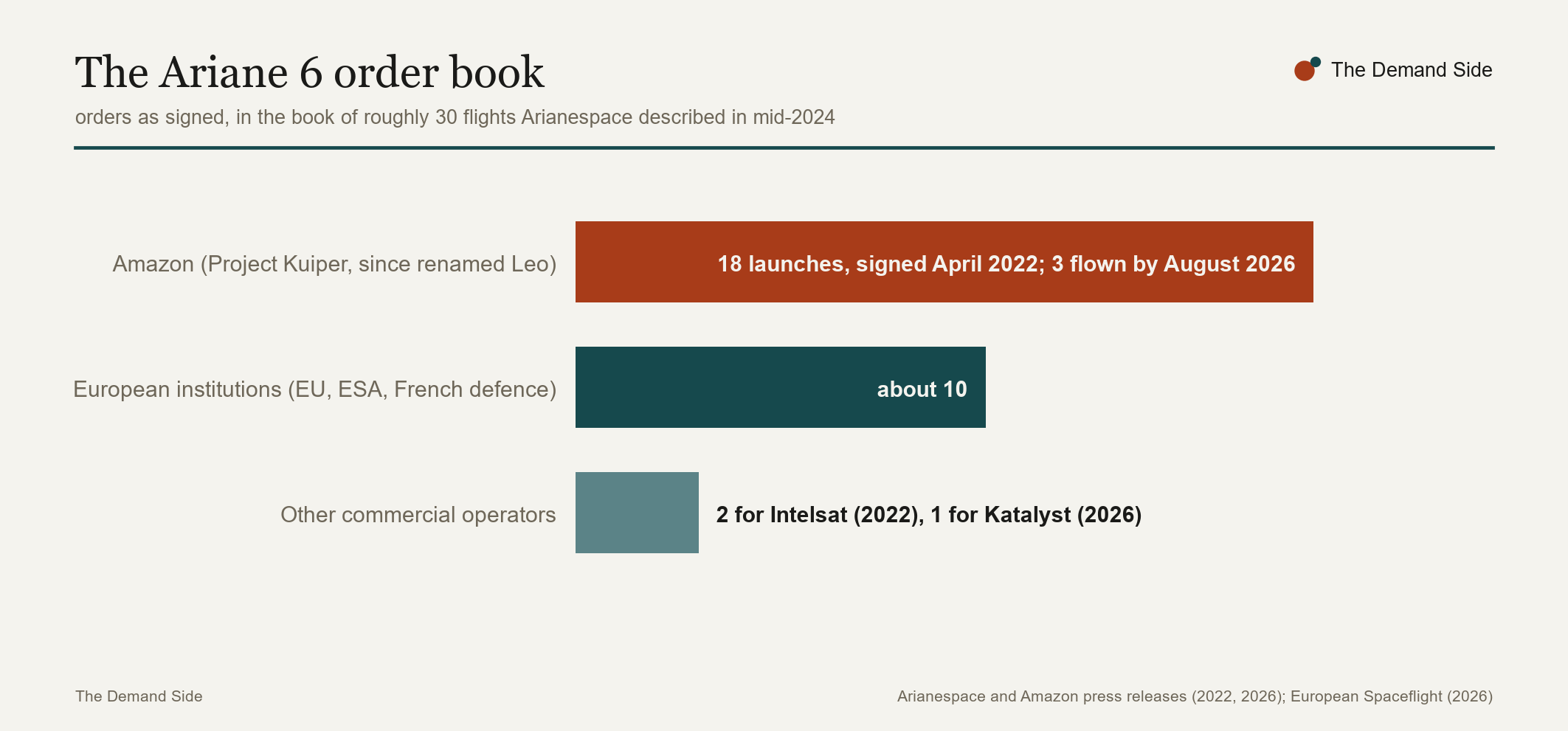
Chart 3. The Ariane 6 order book: one American anchor customer, a column of European institutions, and a commercial remainder of three payloads.
The rest of the book reads institutional: Galileo and Copernicus flights for the European Union, science missions for ESA, satellites for French defence. The commercial remainder, as far as public announcements reach, is two payloads for Intelsat, signed in November 2022, and one servicing spacecraft for the American company Katalyst, signed in March 2026. The most recent new multi-launch framework with a European commercial operator of geostationary satellites is Eutelsat's, signed in 2018. Vega-C's book is institutional too: a record European Commission contract for five Copernicus flights, ESA and national-agency missions, export orders from Asian governments, and Airbus as the rare corporate name.
Execution, from 2023 through 2025, matched the book. Europe conducted thirteen orbital launches in those three years, a failed test flight aside. Three in 2023, all institutional, in a year Vega-C spent grounded after the failure that took Pléiades Neo down with it. Three in 2024, including the Ariane 6 demonstration and a return-to-flight for which ESA paid €51.65 million to launch Sentinel-1C. Seven in 2025: four Ariane 6 and three Vega-C, six of them bought by European institutions and one by a Korean agency as an export order. Arianespace described CSO-3 as Ariane 6's first commercial mission. The paying customer is the French state.
Arianespace's revenue fell from €1.4 billion in 2015 to €152 million in 2024, with €372 million in accumulated losses by the end of 2025, when the company was recapitalised and folded fully into ArianeGroup. At the ESA ministerial in Seville in November 2023, member states agreed to pay up to €340 million a year to support Ariane 6's exploitation across flights 16 to 42, with a further envelope for Vega-C.
4. Where the demand lands instead
The demand did not disappear; it boarded another rocket. SpaceX's Transporter rideshare line alone carried 336 European satellites in the window, nine times what all European rockets combined carried; most of those satellites are small, and the caution under Table 1 applies here in full. Most of them never dealt with SpaceX directly. They went through integrators, and one of the largest of the integrators is European. Exolaunch, from Berlin, has flown on every SpaceX Transporter mission since January 2021, flew its 25th Falcon 9 mission in March 2026, and passed, by its own reckoning, 800 deployed satellites on Transporter-17 in July 2026, with capacity purchased through 2028. D-Orbit, from Como, had flown 22 of its ION transfer vehicles by March 2026, all but the first on Falcon 9. European operators buy launch readily and repeatedly; they buy it from the supplier with a published price and capacity available when the payload is ready.
Europe's institutions bought Falcon 9 too, when schedules were at stake. The European Commission bought two Falcon 9 flights for roughly €180 million to rescue the Galileo deployment schedule, flown in April and September 2024. EUMETSAT's council moved the MTG-S1 weather satellite from Ariane 6 to Falcon 9 in June 2024; its director-general called it a decision “driven by exceptional circumstances,” and the head of CNES called it “a very disappointing day for European space efforts.” ESA's EarthCARE, Euclid and Hera all flew American for want of a European ride. Set the flagships in one row: Galileo, Europe's navigation system; Euclid, its telescope charting the dark universe; EarthCARE, its climate mission; Hera, its planetary-defence probe; MTG-S1, its next-generation weather satellite. Five icons of European public space, all launched on the same American rocket between mid-2023 and mid-2025. Ariane 5 carried JUICE in the same period and Vega-C carried Sentinel-1C: the flagships that flew European were the ones for which a European ride existed when the mission was ready. Each move was the decision any operator makes when schedule risk on the home option exceeds the political cost of the foreign one.
Price sits under all of it, and the two prices on the table are for different products, so they stand side by side rather than compressed into one ratio. SpaceX sells a shared ride to orbit the way an airline sells a seat: the tariff is on the website, $350,000 for the first 50 kilograms to sun-synchronous orbit and $7,000 per kilogram above that as of February 2026, up from the $5,000 of the programme's first flights in 2021, and the same page carries a calculator: choose an orbit, type in the kilograms, read the price. A dedicated flight buys exclusivity, orbit and timing, and there Europe does sell: Vega-C's disclosed institutional missions, single flights and a five-flight bundle, price a dedicated launch at roughly €46 to 52 million for about 2,300 kilograms to the same orbit, which works out to €20,000 to €23,000 per kilogram, an arithmetic this edition does itself because no supplier publishes one. And Europe's new launch generation, seven companies courting commercial customers, keeps no published tariff. The nearest thing to one is a 2021 press release in which Rocket Factory Augsburg named €3 million a launch, a figure the company has not maintained as a price; everywhere else the answer is a contact form.
5. How the American customer buys launch
The first edition reconstructed how NASA bought SpaceX into existence: fixed-price milestones under COTS, then twelve cargo flights in 2008, then crew. That history is told there and not retold here. What follows is the machinery that turned a rescue into a routine, because launch is where it is most visible, and least copied.
America's rockets are the product of a purchasing system.
The pattern the first edition found at company level is, here, a procurement calendar: the same buyer returning to the same suppliers, year after year, for a standardised service.
The National Security Space Launch programme buys access to orbit the way a logistics department buys freight capacity. Phase competitions every five years or so set the supplier pool, and indefinite-delivery contracts keep several suppliers qualified at once, on purpose. Mission orders are then assigned against fixed prices, fiscal year after fiscal year. A provider can win or lose at three recurring moments; a phase loss is survivable because the next competition has a date. Phase 2, in 2020, split roughly $8.5 billion of missions between ULA and SpaceX. Phase 3's Lane 2, awarded in April 2025, put $13.7 billion across SpaceX, ULA and Blue Origin: around 54 missions, ordered across fiscal 2025 to 2029 and flying from 2027 to 2032. An open Lane 1 for newer vehicles runs beside it with annual on-ramps; seven providers sat on the contract by mid-2026, and in July 2026 the Lane 1 ceiling was tripled from $5.6 billion to $17 billion. The same buyer awarded SpaceX $733.5 million of Lane 1 missions in October 2024, $739 million more in January 2026, and $1.6 billion for eighteen Falcon 9 launches in July 2026: three rounds in twenty-one months, the last bigger than the first two combined and two months from requirement to award. And when Vulcan ran late, the Space Force kept ordering ULA anyway, because keeping two qualified suppliers alive is the programme's stated design.
Cargo shows the habit at its longest. Since 2008 NASA has bought 64 space-station resupply flights across two contract rounds from the same recurring suppliers; Northrop Grumman's Cygnus alone has flown 23 of those missions. NASA adds launch providers to its services contracts through annual on-ramps, the civilian mirror of the military lanes.
Reconnaissance shows it at its fastest. Between May 2024 and June 2026, the National Reconnaissance Office launched fourteen missions of its proliferated architecture, every one on a Falcon 9 from Vandenberg; by April 2025 the office said it had launched more than 200 satellites in two years.
The 2025 comparison, one unit at a time. Flown launches bought by institutions: Europe six; the United States government several dozen, a total no single document publishes and this edition does not estimate. Orders assigned in the year: the US Space Force alone placed sixteen Lane 2 mission assignments in two rounds; Europe's counterpart that year was the Flight Ticket Initiative's first five missions. And in the year that ESA's member states agreed to pay up to €340 million so that Europe's own rocket could operate, the US Space Force awarded $13.7 billion of missions in a single lane; in July 2026 it tripled the ceiling of the other lane to $17 billion.
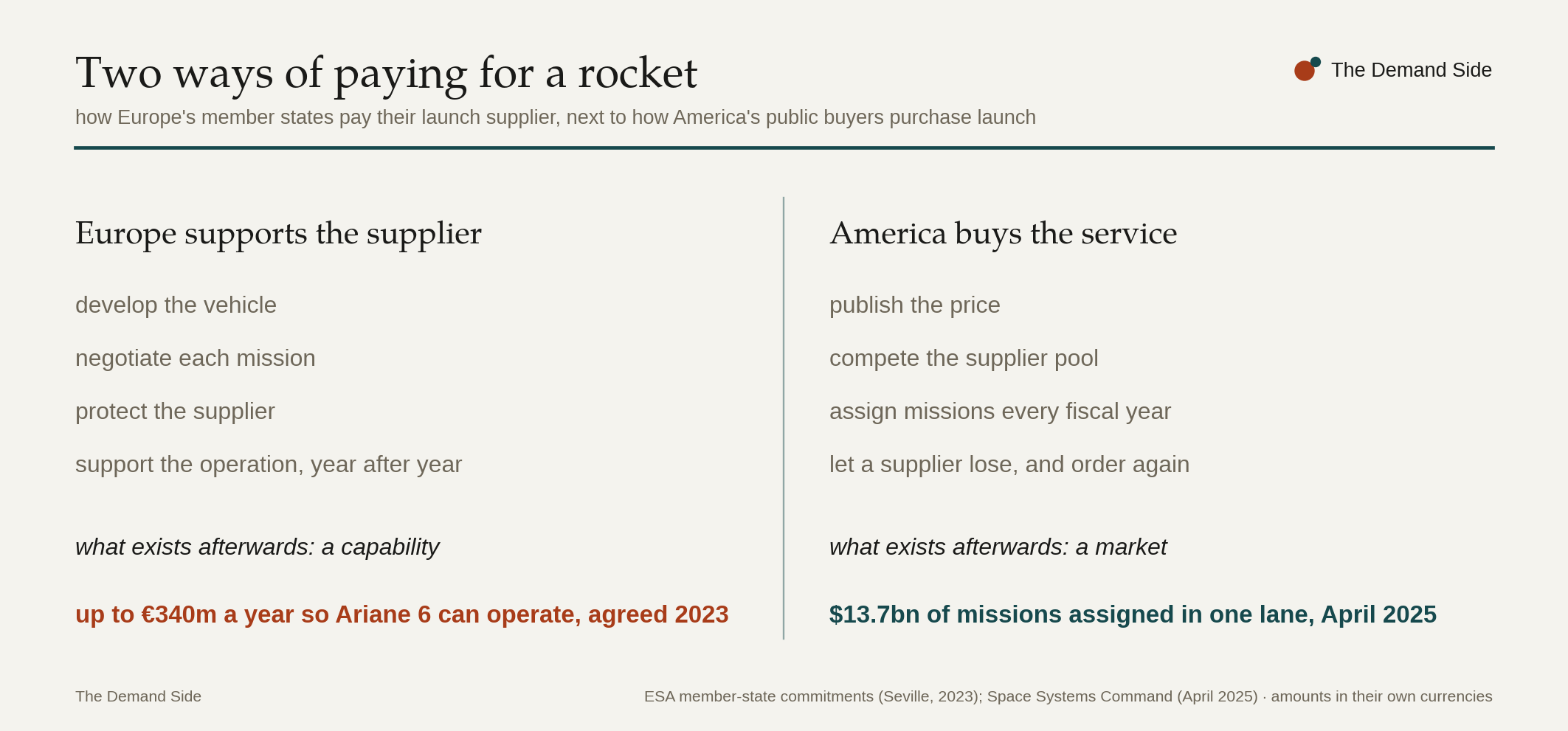
Chart 4. Two ways of paying for a rocket. Europe supports a supplier so the vehicle can operate; America assigns missions against fixed prices, year after year. The amounts are the most recent commitment on each side.
Stéphane Israël, then Arianespace's chief executive, told the French parliament that SpaceX rests on “strong institutional business: this is the condition for a level playing field.” He was asking, in effect, for a customer.
6. The new generation: contracts before flight
Seven ventures make up Europe's new launch generation: Isar Aerospace, Rocket Factory Augsburg, MaiaSpace, PLD Space, Latitude, Orbex and HyImpulse. As this edition closed on 8 August 2026, the operational record of the seven combined stood at one orbital test flight, Isar's in March 2025, which was lost about thirty seconds after liftoff. RFA ONE stood destacked at SaxaVord after an issue found in pad testing, its August window cancelled and no new date public; Isar's second Spectrum, the qualification flight and the first to carry payloads, had a launch date of 31 August that slipped, with the next attempt set for 4 September as this edition went to press; none of the other five had attempted an orbital flight, and Orbex announced in February 2026 that it would appoint administrators and withdrew from the European Launcher Challenge. This status changes from month to month. The structure behind it will take longer to change.
Because nothing has been delivered, no customer in this generation has ever faced the simplest test of demand: whether to buy again. Every order in the segment is a pre-flight order. The more useful question is what sits behind those orders.
Public anchors first, and lately a thin line of private ones. Isar holds the fullest book: a Norwegian order for two maritime-surveillance satellites to fly from Andøya, two ESA Flight Ticket missions, a US dedicated mission, and private orders signed in 2026 from Astroscale and Planet. RFA holds two Flight Ticket missions and demand from its shareholder OHB's group companies; Latitude's first commercial flight carries CNES; MaiaSpace, an ArianeGroup subsidiary, holds a multi-launch agreement with Eutelsat for OneWeb replenishment between 2027 and 2029, value undisclosed and signed in January 2026 with a vehicle that has never flown.
The order that stands apart in kind belongs to PLD Space. Sateliot, the Spanish connectivity operator, bought a dedicated Miura 5 mission for two of its satellites in 2027, billed by both companies as the first fully private Spanish space mission, and still the only dedicated mission a commercial operator has bought from a launcher in its own country. One operator, buying a dedicated mission on an unflown national rocket, is a small fact. It is also the kind of order missing everywhere else in this count: a commercial customer choosing a domestic supplier for a standardised service.
One buyer shows the other side of pre-flight demand. D-Orbit, the Italian transfer-vehicle operator that flies constantly on Falcon 9, has signed launch agreements with three of the new providers: HyImpulse in 2021, Orbex in February 2025, PLD Space in April 2025, each before any of the three had flown. D-Orbit is hedging future capacity, which is sensible. It is also the reverse of the pattern that built the American companies: these orders come before delivery rather than after it. Orbex has since entered administration. Pre-flight orders are real commitments, but they can still disappear.
Pre-flight anchors from Norway, CNES and ESA are exactly what public first customers are for, and the first edition praised that behaviour in its American form. The difference is what stands behind the anchor. An American vehicle that flies enters a purchasing machine that assigns missions every year for a decade. A European vehicle that flies, as of this edition, enters a market whose recurring institutional customer bought six launches last year, and whose commercial customers come to four cubesats in forty-three months.
7. The buyer Europe is starting to build
There are four reasonable objections to this reading.
Sovereignty first. Access to orbit is a public good, and measuring a public good with a commercial ruler misses its point. Granted entirely; this edition only asks whether the way Europe pays for sovereign access also builds a supplier that can live on customers, and the American comparison stands precisely because it is a sovereignty programme run as procurement, by defence and intelligence buyers.
The capacity gap. For most of this window Europe had little to sell: Ariane 5 retired in mid-2023, Ariane 6 arrived in mid-2024, Vega-C spent two years grounded. True for the institutional migrations of section 4. It does not explain the commercial book: the last new commercial GEO framework dates to 2018, five years before the gap opened, and Amazon booked eighteen flights on an Ariane 6 that had never flown, which settles whether an unflown rocket can take a commercial booking.
The counting unit. A satellite is not a purchase, and by mission the ledger reads 13 European launches against 12 Transporter flights. Section 2 publishes both units for that reason, and the weight here rests on the number that survives either choice: four commercial satellites, on two missions, across the whole window.
The rideshare limit. Cubesat rideshare is not a market a launch company lives on, and a rideshare slot is no substitute for a dedicated mission, so the 475 commercial satellites say as much about Europe's missing rideshare product as about its missing customers. That is a real limit of this measurement, and it is why the order books of sections 3 and 6, which deal in dedicated missions, carry half the argument. But changing the unit does not change the underlying problem: the recurring institutional customer that anchors suppliers elsewhere is, in Europe, only now being built.
The shift from funding capability to buying services, which the first edition called for, has begun in this segment. Three programmes show it, and they do very different things.
Boost!, ESA's support programme, is sponsorship: €44.22 million of development money across four companies in November 2024, no purchase attached. The Flight Ticket Initiative is a customer: a joint instrument of ESA and the European Commission buying specific missions, most of whose booked payloads are commercial European products. Its first five went to Avio and Isar in August 2025, two more to RFA in January 2026, and the window opened to further providers in 2026. Seven bought missions across three providers is a small number, and it is a public buyer paying for delivery instead of development.
The European Launcher Challenge is the test at scale, and the €902 million is routinely reported as one number. Component A buys launch services for ESA and other European institutional customers between 2026 and 2030; Component B co-funds a capacity upgrade, with at least 40 percent private co-funding required. At the ministerial in Bremen in November 2025, member states subscribed €902.16 million against ESA's stated target of €169 million per challenger. About €276 million sits in Component A, the buying side. About €509 million sits in Component B, the capacity side, which is sponsorship rather than purchase; the remainder, mostly the United Kingdom's subscription, is not yet assigned to a company. On 27 August 2026, ESA signed the first three contracts, €197.8 million for Isar Aerospace, €186.9 million for Rocket Factory Augsburg and €158.9 million for PLD Space, €543.6 million together. MaiaSpace was not among them; ESA said that award process would resume in the coming weeks. The Component A buying begins only once a company reaches orbit, with the end of 2027 as the deadline; the Component B upgrades must be demonstrated by the end of 2028. The contract texts, which would show how firm the mission orders are, are not public.
IRIS², the EU's secure-connectivity constellation, is the largest demand block on the horizon: a twelve-year concession signed in December 2024 for around 290 satellites and roughly €10.6 billion, revised on 7 August 2026, the day this window closed, to 348 satellites and €15.6 billion, with the first satellites now expected in 2029. Launch requests went out in late 2025 under a declared European preference. In January 2025 ArianeGroup's chief executive said the company must “quickly reach an agreement” with the operating consortium, the language of allocation rather than of a tender it would enter. If it proceeds as an allocation, IRIS² will be institutional demand in commercial packaging: real, large, European, and assigned rather than competed. The Draghi report calls Europe's institutional demand for launch a fraction of American and Chinese demand, and prescribes European preference and pooled anchor purchasing. Organised institutional demand is the available European answer, and the American record says it can work. It also shows what that looks like in practice: fixed prices, several qualified suppliers, orders placed year after year, and a customer willing to let a supplier lose.
8. The vacancy signal
In the 100-company hiring panel this publication counted in July 2026, a panel that does not include every venture named above, the European launch companies were advertising 163 roles on their own careers pages; five were commercial roles. A company that has not flown recruits engineers first, and that is the right order. The aggregate is still lopsided: a segment recruiting to build vehicles, and barely to sell them.
The first edition placed Isar with the sentence that its position reflects the market more than the company. Section 2 quantified that market: 0.8 percent of commercial European satellites on European rockets, none of them primary. Engineering alone does not change that number. A buyer does.
9. What would change this reading
This publication measures, so it should say in advance what would change its conclusions. Five developments would.
First, the content of the European Launcher Challenge contracts signed on 27 August 2026: firm mission commitments with numbers and prices would make Component A the first NSSL-shaped instrument in European history; capacity funding with purchase options would make it Boost! at larger scale. The announcements give the totals and the conditions, not the order book. The text of those contracts remains the document to read.
Second, a commercial primary payload of a European operator on a European rocket. Section 2 found none in its window; the last attempt before the window was lost with its rocket in December 2022. One flight would end a streak that has now run the full length of the window.
Third, a second order at any new European launcher placed after a successful first flight, and stronger, a returning customer anywhere in the generation. Repeat purchase after delivery is the demand signal every American case in edition 1 shares, and it is the one signal this segment cannot yet show.
Fourth, conversion of the two large anchors: Amazon's remaining Ariane 6 flights, and Eutelsat's MaiaSpace agreement, announced with flights from 2027 while the vehicle's own maiden flight has since moved to the second half of that year. Anchors that fly become order books; anchors that slip go back into the conditional column.
Fifth, the shape of the IRIS² launch awards: competed across European suppliers, or allocated to the incumbent. Both satisfy the preference. Only one of them builds a market.
When these satellites are counted again, the same two numbers will be read against the marks this edition sets down: 5.3 percent of European-operator satellites on European vehicles, 0.8 percent of the commercial subset. Movement in those numbers is the measurable version of every reform promise above. A later edition will take the same instruments to space situational awareness, where public buyers again dominate and the commercial case is again asserted more often than measured.
The first edition predicted that measuring this segment would be uncomfortable. The commercial subset came to 0.8 percent.
A rocket that is funded is not yet a market. A market is what exists once a customer has bought the flight, received it, and come back for the next one.
Europe has started buying. The next test is whether anyone comes back.
Method, sources and disclosure
The satellites. Section 2 rests on a list built for this edition: every free-flying satellite of an operator headquartered in the EU-27, the United Kingdom, Norway or Switzerland, launched between 1 January 2023 and 7 August 2026, coded by operator (not builder), one line per satellite or per sourced constellation batch: 643 satellites in 331 lines. Each line carries the operator, its country, the builder where findable, the launch date, the mission, the vehicle, the number of satellites and the source; each mission additionally carries its launch site, recorded with its own source. Principal sources are Gunter's Space Page satellite pages, crossed with launch-provider, integrator and agency press releases and trade reporting. The rules were fixed before the counting started: failed launches count, with a note; transfer vehicles and the satellites they release both count, on the original rocket; station-deployed satellites count on the carrying vehicle; subsidiaries code to group headquarters, with a note; hosted payloads are out; whatever could not be hard-sourced was excluded, with the sources tried on record. The list was assembled in batches and merged by a script that checks every line and every batch total and refuses to continue on any mismatch, and the merged result was compared against an independent read-through of the complete 2023 to 2026 orbital launch chronology, to catch missions the batches missed. A hostile re-verification on 8 and 9 August 2026 found thirty satellites this process had missed, most of them in the tails of the largest rideshare manifests; they are included above, the reconciliation between read-through and list is now enforced mechanically, and the headline shares moved by two tenths of a point. The working record is archived; corrections are made in the open. Known coverage limits, each of which would add satellites on American vehicles rather than European ones: station-deployment and small-dispenser manifests are incompletely public; the largest rideshare manifests are not fully broken out by payload in public sources, and a handful of named payloads whose operators could not be pinned down were left out, by name, in the working record; satellites still aboard transfer vehicles at the close are not yet counted. Missed satellites would almost certainly sit on American vehicles, so the Falcon share is more likely understated than overstated. The counting charts, the map and Table 1 are generated from the same list by scripts that re-check the totals before drawing, so none of their numbers is typed by hand; Charts 3 and 4 carry the programme figures named in the text.
The vacancy count (section 8): advertised roles on the companies' own public careers pages, counted in July 2026 across a fixed panel of 100 European space companies and classified by job title against a fixed rubric. The panel composition and the rubric are published at hugovandehaar.com.
Verification. Before publication the author drew five satellites at random and verified them by hand against their sources. The check changed nothing.
Own arithmetic, labelled as such in the text: the Vega-C price per kilogram (from disclosed mission prices of €46 to 52 million, single flights and a five-flight bundle, and a nominal 2,300 kilograms); the sixteen Lane 2 mission assignments of calendar 2025 (the April and October rounds added together); the Component A and Component B totals of the European Launcher Challenge (added up per column from the country table in ESA/C-M(2025)100); the fourteen-launch NRO series (assembled from NRO press-release titles and cross-checked trade reporting, as the NRO does not publish a series list); the observation that one European buyer booked three unflown providers (from the three companies' own announcements); currency conversions, which are approximate and marked.
Principal sources. Arianespace and Amazon press releases on the April 2022 agreement; Arianespace and Eutelsat releases on the 2018 framework; Avio and European Commission releases on the Vega-C book; European Spaceflight on Arianespace's finances, the €340 million exploitation support and the 2023 to 2025 European launch record; ESA releases and payments on Sentinel-1C; SpaceNews and EUMETSAT on the MTG-S1 decision and the Galileo Falcon 9 purchases; SpaceX published rideshare pricing; Exolaunch and D-Orbit company releases on their Falcon 9 record; the Congressional Research Service defence primer on NSSL (IF12900); Space Systems Command releases and notices on Phase 2, Phase 3 Lane 2 and the Lane 1 rounds, with SpaceNews on the July 2026 ceiling increase; NASA award records, mission pages and the NASA Office of Inspector General (IG-18-016) on the resupply contracts and Cygnus flights; NRO press releases and Spaceflight Now on the proliferated-architecture series; ESA releases and programme pages on Boost!, the Flight Ticket Initiative and the European Launcher Challenge, including the public CM25 subscription document (ESA/C-M(2025)100), read directly for the per-component split, and the ESA announcement of 27 August 2026, with European Spaceflight, on the first three ELC contracts; company and agency releases on Isar, RFA, MaiaSpace, PLD Space, Latitude, Orbex and HyImpulse contracts and flight status, including the Norwegian Space Agency, Sateliot, Astroscale, Planet, Eutelsat and CNES, and European Spaceflight on the MaiaSpace schedule; Arianespace and Katalyst releases on the March 2026 Katalyst order; ses.com and European Spaceflight on IRIS², its European preference and the revision of 7 August 2026; the Draghi report (2024), Part B, space chapter, on Europe's institutional demand for launch and its procurement prescriptions; SpaceX's published rideshare page, read on 8 August 2026, for the tariff and the calculator. Launch sites per mission are from Gunter's Space Page chronology and satellite pages, provider and operator announcements (Exolaunch, Rocket Lab, Kinéis, Eutelsat, D-Orbit) and the public launch lists, recorded mission by mission alongside the satellite list; the map's coastlines are Natural Earth (public domain). Flight status of RFA ONE and Isar's second Spectrum was last verified on 1 September 2026.
The Demand Side is an independent analysis of demand in the European space and deep-tech economy, written by Hugo van de Haar. Corrections, criticism and disagreement are welcome at hugo@vandehaar.com. What changes a figure is corrected in the open.
Edition 002, 14 pages. Published under the Creative Commons BY-NC-ND 4.0 licence: free to share with attribution, unchanged and non-commercially.
Archived with a DOI: 10.5281/zenodo.22162467. Cite as: van de Haar, H. (2026). The Missing Customer. The Demand Side, Edition 002.
Previous edition: 001 · The Best Customer on Earth
One email when a new edition is out.
I only use this list to send new editions. How your email address is used.