Demand-Side Teardown · A worked sample
Sample teardown
A fictional propulsion company has a product in qualification and no product orders. This review examines which prospect it should pursue first, using the Demand Transition Framework and real purchase announcements.
Download the full teardown as a PDF →Fictional company, real purchase sources
A propulsion supplier’s first customer
The unit is in qualification. Two prospects have signed non-binding letters of intent, but neither has placed a product order. The review examines whether a prospect has a suitable mission and the budget to buy the unit.
The company is fictional. The five purchase announcements are real. You can read the review below or download the PDF.
Open the sample PDF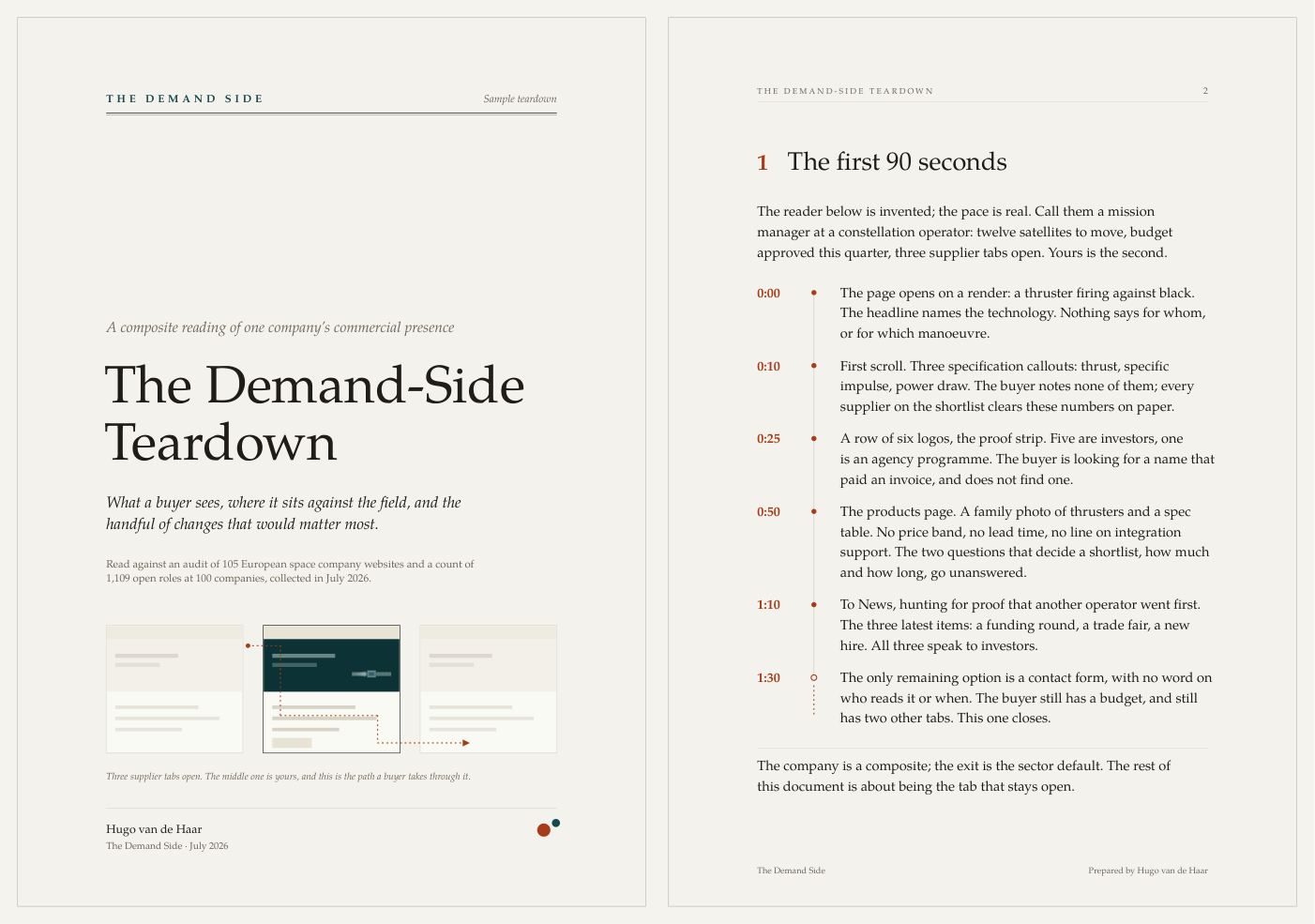
A propulsion supplier’s first customer
A fictional company with a product in qualification and no product orders. Which prospect should it pursue first, and what would turn that interest into a purchase?
This company and its sales material are invented. The purchase announcements later in the example are real. Recommendations are my interpretation of the stated facts, not findings from customer interviews.
The situation
A European start-up is developing an electric propulsion unit for small satellites. Its work is supported by a public grant and paid engineering work for a public programme. The grant finances development; the engineering contract earns revenue. Neither is a sale of the propulsion unit.
Qualification is under way and the unit has not flown. The founders handle sales alongside engineering. Their deck describes the unit as available and lists two letters of intent from constellation start-ups.
Both letters are non-binding and depend on the prospects securing funding and launch dates. Neither specifies a quantity or price.
My recommendation
Before widening outreach, review the existing prospects for a mission that fits the unit, a funded purchase and acceptance of its development status. Keep the two letters in the pipeline, but do not count them as customers. The next pages explain that recommendation using the Demand Transition Framework and public product orders.
Demand Transition Framework
The framework separates customer-base maturity from business-model repeatability. It helps distinguish a funded development project from a product people have bought.
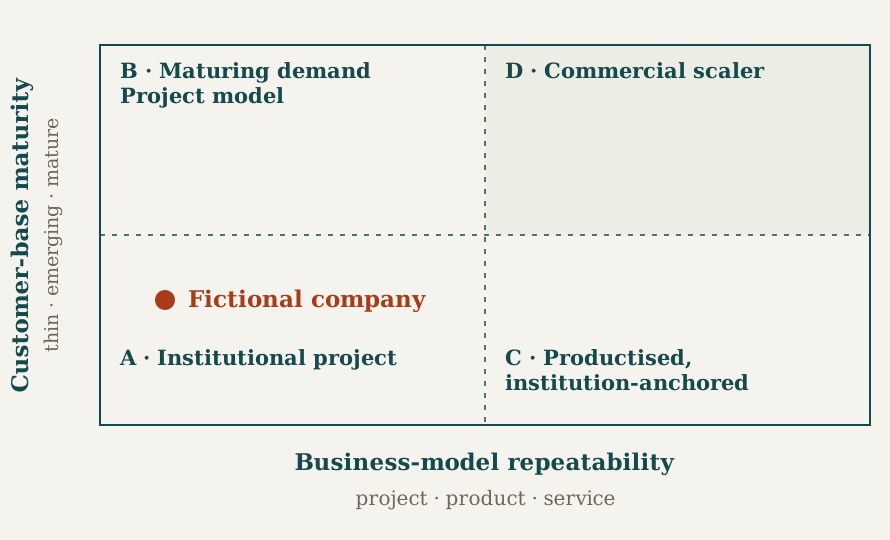
I place this fictional company in A: its paid work is still project work, its product has no buyers and its prospects are conditional. The product is designed for repeat sales, but those sales have not happened. This is an illustrative judgement, not a measured score.
For this company, the immediate commercial test is a paid order for the defined unit. A batch order would be useful evidence of product demand. Sales to further customers or a returning customer would provide more evidence of repeatability.
A public agency can buy that unit too. The review therefore records both who pays and what they buy: development work or an existing product. It does not treat every public contract as the same kind of demand.
Adapted from the public framework in Edition 001. The published positions describe selected cases; they do not predict this company’s outcome. Method: hugovandehaar.com/framework.html.
Announced product orders
These five announcements establish that several buyers have ordered propulsion products. They do not establish who would buy an unflown unit from this fictional supplier.
| Buyer | Supplier / product | Quantity | Delivery | Article |
|---|---|---|---|---|
| EnduroSat | ENPULSION Integrated electric propulsion systems | 100 | First 30 within twelve months | Dec 2024¹ |
| Dhruva Space | Exotrail spaceware micro | 14 | By 2027 | Feb 2026 |
| Pixxel | Exotrail spaceware | Not stated | Through 2027 | Feb 2026 |
| Muon Space | Exotrail spaceware micro | 5 | Not stated | Aug 2023 |
| CNES | ThrustMe NPT30-I2, off the shelf | “Several” | Not stated | Feb 2024 |
The buyers have different activities. Pixxel builds and operates imaging satellites; Muon develops climate satellites; Dhruva supplies satellite platforms and mission services. EnduroSat is a satellite supplier, and CNES is a public agency. These are examples to investigate, not a shortlist of prospects.
For this review, the useful distinction is that the announcements concern product orders. The CNES purchase explicitly concerns off-the-shelf equipment. A public buyer can therefore be relevant to the supplier’s product-sales objective.
Muon’s announcement explicitly describes a first contract between the two companies. None of these five announcements establishes a repeat order by the same buyer. Quantities, delivery periods and contract values are not consistently disclosed.
¹ December 2024 is the publication month of the cited EnduroSat article, not a verified date of the original announcement. See Sources for the references and reading dates.
Choosing the first prospect
The five announcements do not show whether an operator or a platform builder is likelier to buy first. The choice rests on the supplier’s actual prospects. I would compare them against four conditions.
| Condition | What to establish |
|---|---|
| A suitable mission | Which satellite would use the unit, and when must it be delivered? Does that schedule allow for the remaining qualification work? |
| A product that fits | Can the defined unit meet the mission requirements without a new development project? Have the engineering teams checked the fit? |
| A funded purchase | Is money available to buy the unit? Who can approve the order, and what must happen before they do? |
| Accepted status | Does the buyer understand that qualification is under way and the unit has not flown? Record the agreed acceptance criteria before contracting. |
The two letters of intent do not establish a funded purchase or a delivery commitment. They justify a follow-up to ask what would turn interest into an order. If neither prospect can identify a budget or decision date, I would widen the search rather than present the letters as sales evidence.
Permission to name a customer would help later sales, but it is not a condition for accepting an order. A confidential purchase still counts. Agree separately what may be disclosed about the customer, mission or completed work.
Still to establish
The example has no real prospect discussions or test reports. A commissioned review would examine the records the company shares, including reasons enquiries stalled. Technical fit and qualification acceptance remain decisions for the engineering teams; external customer interviews are outside the standard teardown.
Changes to the sales material
The material should describe the unit that exists today and the conditions for ordering it. These extracts are from the fictional case.
| In the material | Recommended change |
|---|---|
| “Available” in the deck | State that qualification is under way and there is no flight heritage. Distinguish discussions about future delivery from ready-to-ship stock. |
| Two letters shown as customers | Move them to the pipeline. State that they are non-binding and depend on funding and launch dates. |
| Programme logo as evidence | Keep it labelled as programme support. Put test status and relevant documentation beside the product description. |
| Different descriptions in the deck and founder profiles | Use the same unit, intended application and status across the proposal, deck, product page and profiles. |
Electric propulsion unit designed for satellites of 20 to 200 kg, combining thruster, power unit and tank. Qualification is under way; the unit has not yet flown. Send your satellite mass, orbit, required quantity and target delivery date. We will review the fit with your team and discuss the remaining qualification work before quoting.
The proposed enquiry asks for information relevant to assessing the mission and delivery. The company must agree the inputs and response process. It promises neither completed qualification nor a fixed response time.
The passage shows the direction of the recommendation. Standard teardown copy is yours to write.
Applying the review
For the fictional supplier, the prospect decision comes before a broader rewrite.
What the fictional supplier should do
Review the prospects against the four conditions. Correct the product status and move the letters of intent to the pipeline. Agree the enquiry process. Use one product description across the sales material. Link specifications and test documents to the version they describe.
If your company has a similar decision
We agree one buyer segment and one commercial decision. I research purchases and contracts, review your material and explain what I would change and why. Where relevant, the Demand Transition Framework supports the assessment.
| You receive | Detail |
|---|---|
| Written review | Recommendations, supporting evidence and the information that could not be established. |
| Comments on your material | Annotated extracts of the proposals, product pages or deck we agree to review. |
| A call with your team | We discuss the findings and the proposed changes. |
| €2,500 excluding VAT | One buyer segment. Half invoiced on acceptance, half on delivery. |
Scope and delivery date are agreed before starting. Private material stays confidential. Implementation, customer interviews, introductions and copywriting are outside the standard scope.
A paid teardown can cover the positioning phase of a Positioning Sprint booked within 30 days of delivery. Scope and conditions: hugovandehaar.com/sprint.html.
hugo@vandehaar.com · hugovandehaar.com/book
Sources
The company is fictional. These are the public sources used for the purchase examples and the framework.
1. EnduroSat, Bulgaria / ENPULSION, Austria
12 December 2024 · “100 fully integrated electric propulsion systems”
Read source
2. Dhruva Space, India / Exotrail, France
17 February 2026 · “14 spaceware™ - micro systems to be delivered by 2027”
Read source
3. Pixxel, India / Exotrail, France
17 February 2026 · “with deliveries extending through 2027”
Read source
4. Muon Space, United States / Exotrail, France
24 August 2023 · “Exotrail and Muon Space have signed their first contract”
Read source
5. CNES, France / ThrustMe, France
6 February 2024 · “several off-the-shelf propulsion systems”
Read source
6. The Demand Transition Framework
Edition 001, Figure 1, 2026 · “Customer-base maturity and business-model repeatability”
Read source
Purchase sources first read 15 September 2026. Four supplier announcements rechecked 20 September; EnduroSat uses the cited trade-press article, checked on 20 September. Article dates are not delivery dates.
The announcements report orders. They do not prove delivery, payment, customer satisfaction or suitability for the fictional unit. Product status in the case is invented; no company or customer was interviewed for this example.
Discuss your project
€2,500 excl. VAT for one customer group. You receive a written review and comments on your sales material, followed by a call to discuss the recommendations.