Working together · Demand-Side Teardown
Demand-Side Teardown
A teardown begins with one agreed group of buyers and the question your material has to answer for them. I check your deck, proposal or product page against what those buyers have bought, from whom, and what they used instead of something like yours. My recommendations come in writing, and we go through them on a call.
€2,500One buyer segment · excl. VAT
Book a callOne question, one group of buyers
We agree the question before I start. For an Earth-observation company selling to insurers, it might be whether to lead with flood claims or with crop damage. To answer it I look at three things in your material and in the market.
- Who signs
- Who in the buyer’s organisation needs the product, who can approve the purchase, and what they would use it for.
- Why you
- What you sell, and why a buyer would choose it over another supplier or over doing the work in-house.
- What backs it up
- Whether your customer examples, contracts and product information support what the material says.
The written review
It opens with my recommendation and the changes I would make first, followed by notes on each document we chose, such as a proposal, a product sheet or the deck.
After the call you have 30 days to send me one revised document. I check it against the recommendations and reply in writing.
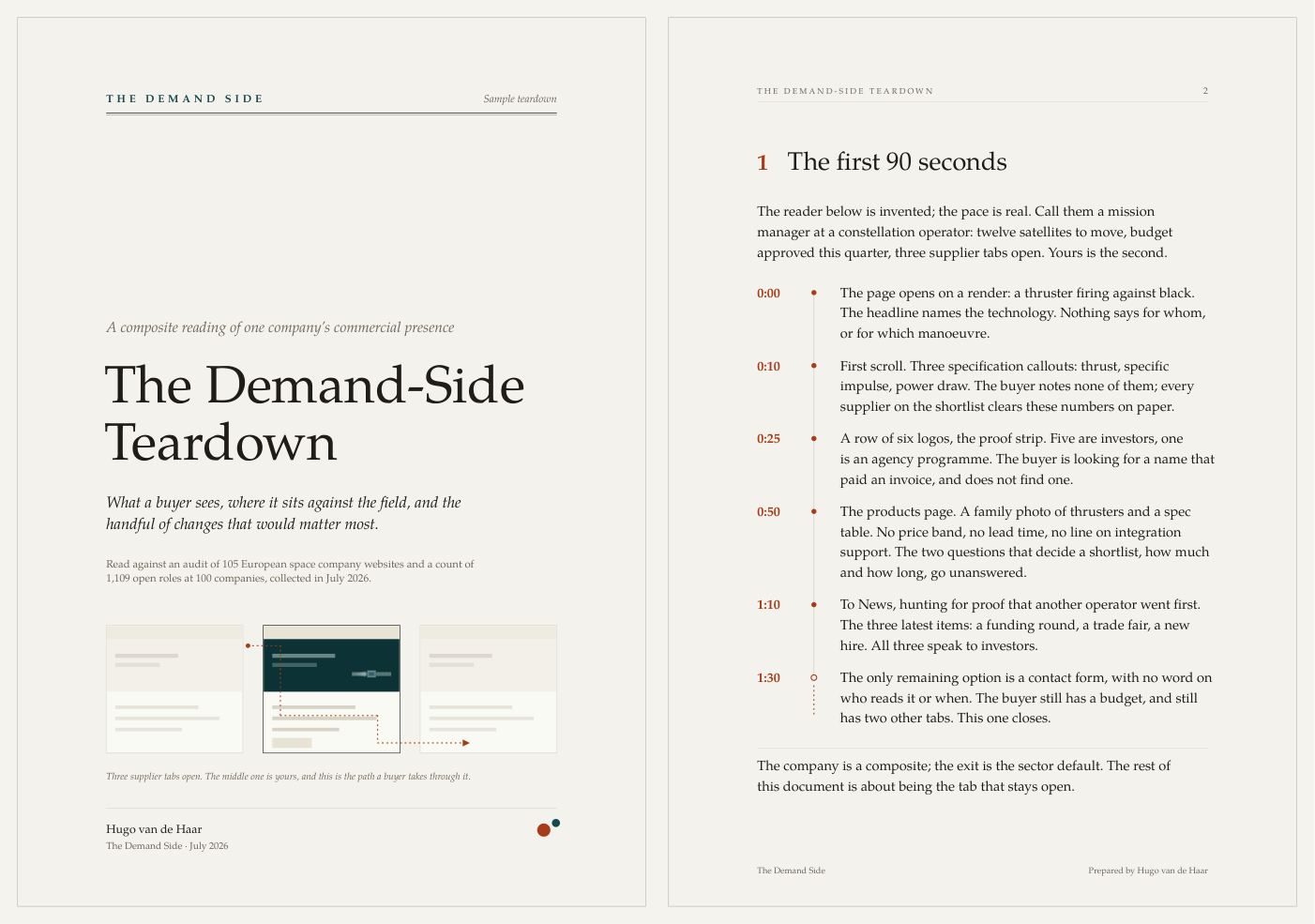
Read an example
The sample follows an invented propulsion start-up with a unit in qualification, two letters of intent and no orders. Using five real purchase announcements and the Demand Transition Framework, it assesses which prospect to pursue first and what to change in the deck.
Read the sample teardownWhat the quote fixes
The quote names the question, the group of buyers and the documents I review, with a date for the first results and one for the finished review. I work from what you already have and start once your documents and the first payment are in.
The check afterwards is written feedback on one revised document for the same buyers. New research, rewriting and interviews with your customers are separate work. Payment and ownership are set out in the project terms.
If you want to continue into a sprint
In a Positioning Sprint we choose the buyer group together and I write the texts named in the quote. You can book one without a teardown first.
Book it within 30 days of receiving the teardown, once the teardown is paid, and that fee covers the sprint’s positioning phase. The rest of the sprint costs €7,000 for one buyer segment or €12,000 from two; the sprint page has the full payment terms.
Discuss your offer
Bring the deck or proposal you would like me to look at to a free 30-minute call.